Phallus impudicus
Taxonomy
Main synonym
Common names
Falo hediondo, Etsai-zakil, Ou del dioble.
Geographic references:
Interactive map with data from GBIF.





Morphological Features:
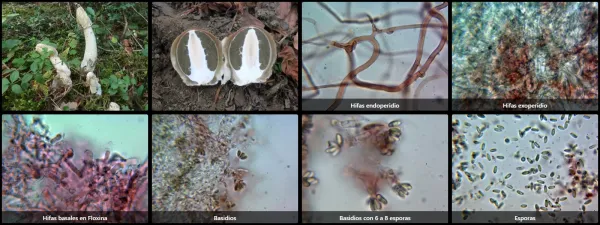
Basidiocarp initially egg-shaped, very soft and gelatinous, with a white external surface. A transverse section through the egg reveals an outer translucent brownish gelatinous layer, followed inward by a green layer that will subsequently develop into the gleba, and centrally, a broader white region that will form the stipe.
Gleba mucilaginous, located at the apex upon specimen development, greenish in color; flies land on it and gradually consume it, ultimately leaving only a whitish, honeycomb-like sterile framework.
Stipe easily exceeding 10 cm in length, hollow and porous like a sponge.
Flesh very fragile, with an unbearably fetid odor.
Habitat:
Occurs equally in coniferous and broadleaf forests; except during winter, it can be found throughout the year. Common and very frequent.
Observations:
Upon entering the forest interior, we know this fungus is nearby even before sighting it, as its nauseating odor can be detected from several meters away. This odor attracts flies that land on the gleba, thereby facilitating spore dispersal. In its egg stage, it resembles other species such as Clathrus archeri, but a transverse section will resolve any doubts. It also resembles Phallus hadriani, which emerges from a pinkish egg.