
Phaeolus schweinitzii
Taxonomy
Main synonym
Common names
Not available
Geographic references:
Interactive map with data from GBIF.
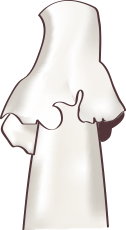
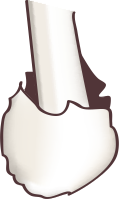
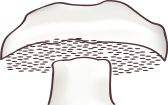
Morphological Features:
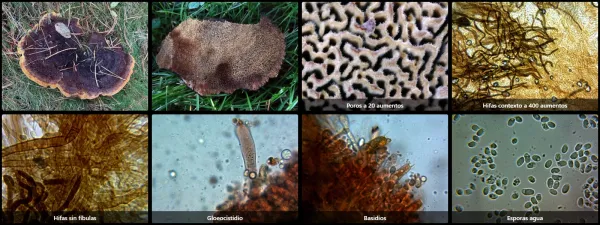
Pileus of considerable size; the diameter of mature specimens generally ranges between 10 and 20 cm, although individuals up to 25 cm in diameter may be observed. Its shape is highly variable; it may exhibit a typical circular form, but sometimes appears reniform, and imbricate pilei can occasionally be found. The surface is pilose or velvety in young specimens, becoming tomentose and eventually smooth in old age, particularly in the central region. When young, it displays a striking sulphur-yellow color, but as it matures it turns brown from the center outward toward the margin, becoming ochre with a ferruginous tinge in old age. The margin is typically thick and rounded, irregularly undulate or deformed.
Hymenium composed of well-sized pores, not exceeding 2 per mm, representing the terminations of tubes that are noticeable near the stipe and reduce to a minimum near the margin. The pores are polygonal in shape and strongly decurrent; yellowish when young, they quickly turn brown and exhibit a slight tendency to blacken when scratched with a fingernail.
Stipe central or occasionally eccentric, very short relative to the pileus size, thick or slightly attenuate toward the base. It shares a similar coloration with the rest of the fruitbody.
Flesh thick, yellowish, and soft in younger individuals; it gradually acquires a cork-like texture while turning brown, becoming very coriaceous in its final stage. It lacks any notable odor or taste.
Habitat:
An annual species almost exclusively associated with conifers, showing a particular predilection for pines; it is very rarely found on broadleaf trees. It fruits directly on old decaying stumps, or sometimes apparently on the ground when sustained by buried roots. It is considered a common and frequent species that fruits preferentially in autumn, typically growing solitarily.
Observations:
A mushroom of decidedly unattractive appearance, characterized by its large size, pilose or tomentose yellow-to-brown surface, and hymenium bearing large pores. Often described as unmistakable, we believe that macroscopically it is by no means easy to distinguish from Onnia tomentosa, a species that shares its habitat, exhibits similar coloration and texture; the only clear differences are its smaller size and finer pores.