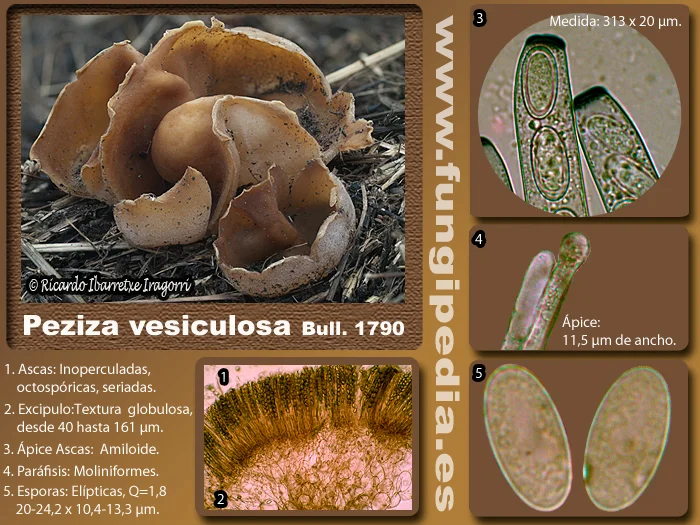
Peziza vesiculosa
Taxonomy
Main synonym
Common names
Peziza vesiculosa, katilu xizkidun, cassoleta.
Geographic references:
Interactive map with data from GBIF.





Morphological Features:
Carpophore globose in shape with a hollow interior during the initial stage of development, gradually opening to acquire a cup-shaped but highly irregular form, and may even be laterally split. It is noteworthy that this species does not flatten out as occurs with other members of its genus. Its size is highly variable, with fully developed specimens measuring merely 3 to 4 cm alongside others reaching dimensions around 8 to 10 (12) cm. The external surface is furfuraceous and even pruinescent in some specimens, imparting a whitish hue; however, it may acquire a more ochraceous tone. The margin is highly irregular; it may be crenulate, undulate, or even fissured, but all of this, I reiterate, occurs in an irregular manner.
Hymenium located on the internal surface of the ascocarp, brownish and more or less light depending on the specimen's condition; it is generally smooth, although some specimens exhibit wrinkles or protuberances derived from the growth form, namely a type of vesicles that give the species its name.
Stipe normally absent, although it is possible to encounter some specimens with a short pseudostipe embedded in the substrate.
Flesh somewhat firmer than in other species of its genus, of variable thickness, with hardly any perceptible odor and a faint taste.
Habitat:
This species has been recorded in spring, although it may also be found during autumn; it is not overly frequent. It fructifies in highly nitrogen-rich habitats containing decomposing plant matter, on straw mixed with livestock manure, or sometimes on alpaca hides exposed to the elements, and occasionally on soil with highly degraded manure. It generally emerges in more or less numerous groups.
Observations:
The list of species that may be confused with this one seems endless; we must first observe the habitat of this species, which is somewhat peculiar, and the vesicular protuberances present in some specimens to approach its macroscopic identification. However, microscopic analysis is indispensable to confirm its classification. Another characteristic to consider is that it does not flatten out as do, for example, Peziza arvernensis or Peziza repanda, which are otherwise very similar.
Microscopy of Peziza vesiculosa