
Peziza varia
Taxonomy
Main synonym
Common names
Not available
Geographic references:
Interactive map with data from GBIF.



Morphological Features:
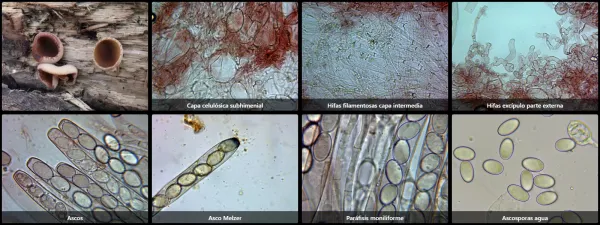
Carpophore highly variable in all aspects, both in habit as well as shape and color. Initially globose, they quickly open to first assume a calyculate shape, then an open cup shape, and when specimens are old, they spread out completely. The diameter of specimens observed in our collection ranges from 0.5 cm for the smallest, in the initial developmental phase, to 5.5 cm for the oldest and most expanded specimen. The color of the external surface varies; in young specimens it is light ochre with an olivaceous tinge, later becoming darker ochre. This surface is furfuraceous. Two-thirds of the observed individuals exhibited a crenulate margin, while the remaining third had a smooth margin.
Hymenium in youth ochre with an olivaceous tinge and smooth, it gradually darkens to become brown; additionally, at this stage it usually exhibits wrinkles or folds. Its septate paraphyses are characteristic, which in old specimens become moniliform; however, observations from the various microscopic samples prepared by Ricardo Ibarretxe indicate that this character is inconsistent, as young specimens from the same collection do not exhibit this type of paraphyses.
Stipe sometimes prominent and at other times absent; this is another of the variable characters exhibited by the species.
Flesh extremely fragile and brittle, breaking with the slightest touch; ochraceous in color, without notable odor or taste.
Habitat:
In this case, found on refractory material within a disused excavator bucket, an unusual habitat indeed, but it can also occur in gardens and generally in soils containing organic matter. Located in February, we understand that it can appear practically year-round if conditions are optimal. It is a frequent species.
Observations:
There is currently a proposal for the unification of the taxa Peziza varia, Peziza micropus, and Peziza cerea, a proposal we accept in the case of Peziza micropus, having observed that the moniliform paraphyses in our collection only manifest in old specimens. Macroscopically, the genus under consideration is highly complex, requiring a detailed study for the correct classification of species. Peziza vesiculosa is similar but grows on dung or in fertilized soils.