
Legaliana badia
Taxonomy
Main synonym
Common names
Peciza parda, Katilu marroi-oliva, cassoleta bruna.
Geographic references:
Interactive map with data from GBIF.





Morphological Features:
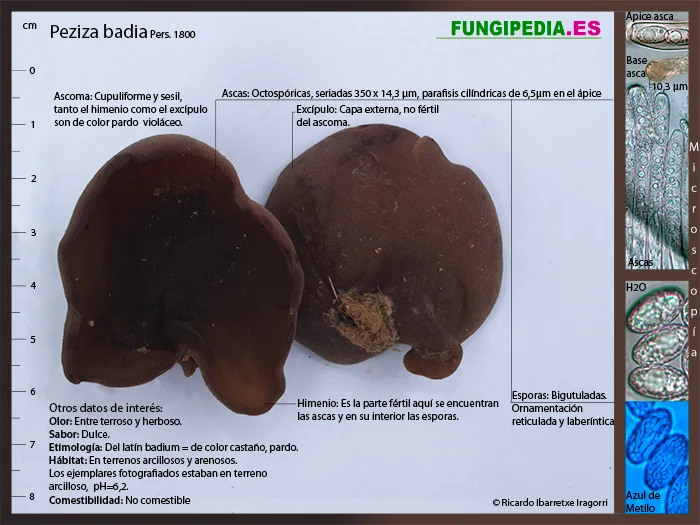
Fruiting body sessile, initially cup-shaped at emergence but rapidly opening to adopt more folded and irregular forms at maturity. Size varies considerably; young specimens may measure no more than 3 or 4 cm across at their widest point, but in mature individuals it can sometimes approach 10 cm. The external surface maintains a uniform color throughout development, violaceous-brown, and is additionally smooth and furfuraceous. Margin generally undulate.
Hymenium smooth, matching the external surface color in young specimens; it only assumes a more distinctly dark brown hue when aged, although olivaceous tinges are occasionally observed.
Stipe absent; it is a sessile species that adheres directly to the substrate.
Flesh fragile and brittle, more or less dark brown in color; odor barely perceptible, taste sweet and insignificant.
Habitat:
Fruiting gregariously on paths or forest tracks, forest edges, and generally on all types of clayey soils. It is primarily an autumnal species that should be considered frequent in our forests.
Observations:
This is a common Peziza in our forests, characterized by its uniform brown color with purplish tints on both the hymenium and the exciple. During spring, a species with similar characteristics fruits, namely Peziza phyllogena; were it not for its different fruiting season, macroscopic separation from this species would be highly difficult, although its spores are verrucose rather than reticulate as seen in the species described here.
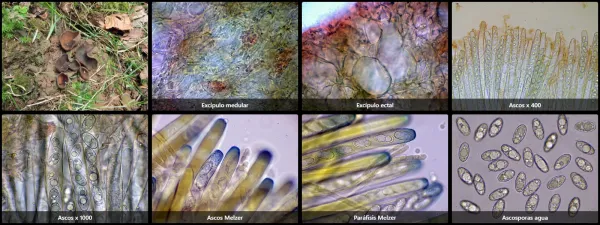
Microscopy of Legaliana badia