Peziza arvernensis
Taxonomy
Main synonym
Common names
Not available
Geographic references:
Interactive map with data from GBIF.





Morphological Features:
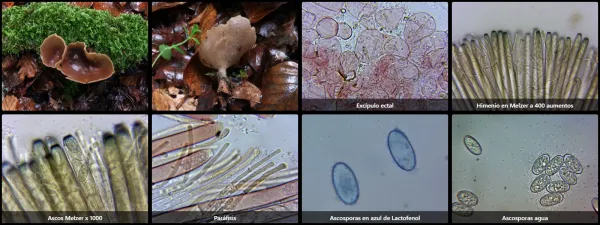
Fruitbody cup-shaped in the early stages of development, later opening considerably and becoming undulate, with old specimens often found practically flattened. Its size is highly variable; it sometimes barely reaches 3 or 4 cm, but specimens over 10 cm in diameter can be found. The margin is regular when young, later becoming involute and irregularly undulate, and the external surface is light ochraceous, finely furfuraceous when hydrated but becoming more distinctly furfuraceous and even pruinescent upon drying; in this state it is much paler, practically whitish.
Hymenium located on the inner surface of the fruitbody, smooth and initially similar in color to the external surface, light ochraceous, gradually darkening over time and with spore maturation to adopt brownish tones.
Stipe absent; it is generally a sessile species, although some specimens possess a sort of pseudostipe formed by the aggregation of mycelial cords.
Flesh fragile and brittle, as is typical for most species of its genus, light ochraceous in color, with little to no odor and a very mild taste.
Habitat:
This Peziza is not overly abundant but is fairly common in its habitat; it grows practically year-round, having been observed by us in winter and spring. It typically appears solitary or in small groups in broadleaf forests, particularly beechwoods, in clearings and mossy areas, as well as along paths.
Observations:
Its preferred habitat in beechwoods and its occurrence even in winter provide clues for identification, along with its ability to reach a considerable size. Macroscopically, it closely resembles other Peziza species due to its coloration, such as Peziza varia, which barely reaches 5 cm at most and prefers a more ruderal habitat. Peziza repanda is also similar, but it lacks the warty spores of this species, possessing smooth spores instead.