
Paxillus rubicundulus
Taxonomy
Main synonym
Common names
Paxilo de los alisos.
Geographic references:
Interactive map with data from GBIF.


Morphological Features:
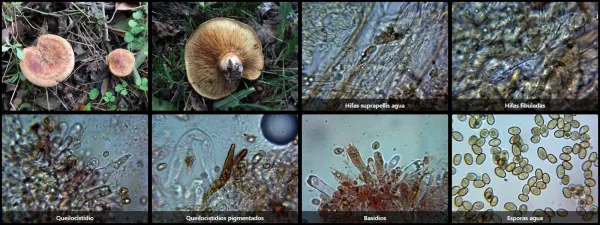
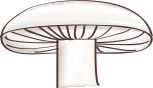
Pileus generally ranging in diameter from 5 to 10 cm, convex in young specimens, gradually flattening, and notably depressed in older specimens, occasionally becoming funnel-shaped. Separable cuticle, ochre with a yellowish tinge initially, staining brown until a dirty brown color ultimately predominates; initially quite smooth but becoming markedly scaly over time. Margin involute for much of its development, then plane and thin, finally undulate, frequently striate or grooved when old, this being a character subject to considerable variability.
Lamellae decurrent, yellowish when young, brown at maturity, very crowded and somewhat irregularly arranged, frequently forked. Staining dirty brown upon the slightest friction or handling, and separable from the pileal flesh.
Stipe short, occasionally central but more frequently eccentric, slightly attenuate at the base, yellowish-ochre turning brown with age, solid.
Flesh compact and firm, quite bright yellow, gradually turning brown when cut. Taste pleasant; odor fungoid and mild.
Habitat:
This is a species that forms mycorrhizae exclusively with alders (Alnus sp), where it typically appears solitary or in small groups. It is an eminently autumnal species and considerably less frequent than other species of its genus.
Observations:
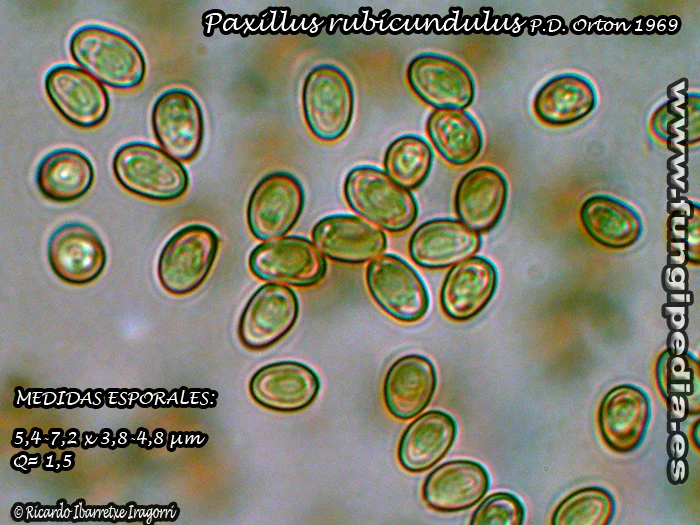
As was once the case with Paxillus involutus, it still appears as edible in some field guides; however, it contains the same thermolabile hemolytic toxins as that species. Since the quantity of these toxins it contains has not been studied, we list it as toxic, though it could well be potentially deadly poisonous. The differences between the two species pertain exclusively to their habitat and to the size and shape of their spores. Tapinella atrotomentosa has a thick, hairy stipe, as well as a more lignicolous habit.
Microscopy of Paxillus rubicundulus