
Psathyrella conopilus
Taxonomy
Main synonym
Common names
Satirela conópila
Geographic references:
Interactive map with data from GBIF.

Morphological Features:
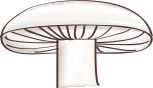
Pileus with a diameter that generally ranges between 2 and 4 cm, initially conical in shape, evolving into campanulate forms; in old age it tends to spread somewhat but never becomes fully flattened, as it always maintains a raised or umbonate center. The cuticle is glossy reddish-brown when the specimen is hydrated, typically drying out to acquire beige or nearly whitish tones, thus characterizing it as a hygrophanous species. Margin fairly regular, slightly striate by transparency, with this striation not extending excessively toward the center.
Lamellae adnate, ascending in young specimens, quite long and moderately crowded, grayish-brown when immature and later purplish-brown due to sporulation, with a white lamellar edge.
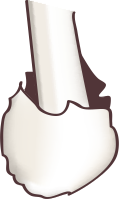
Stipe in most cases disproportionately elongated relative to the pileus, light-colored, whitish or cream, cylindrical, with the apex generally quite pruinose; the base typically contains mycelial remnants. It is hollow from an early stage.
Flesh scant and thin, cream-colored, except beneath the cuticle where it is browner; sweet-tasting though somewhat bland, with no appreciable odor.
Habitat:
This is a saprotrophic species that shows no particular predilection for any specific forest type; it fruits on highly diverse plant debris as well as wood chips. Our collection was made in the latter habitat, on the wood chips typical of a public garden. It is a relatively common or at least widely distributed species that typically appears in more or less numerous groups and can fruit practically year-round if conditions are favorable; our collection dates from March.
Observations:
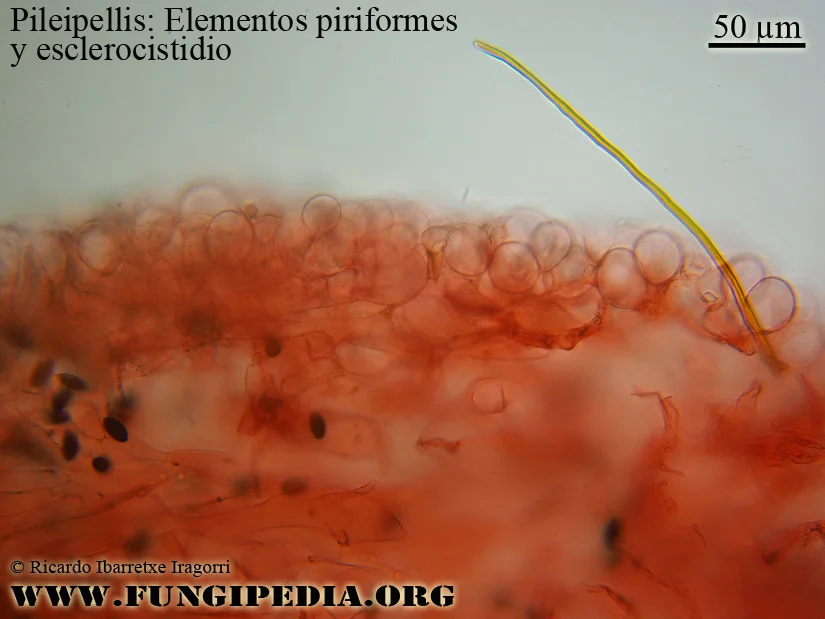
Recently transferred to the genus Parasola largely due to the presence of sclerocystidia and supported by recent molecular studies, although it is still more commonly known as Psathyrella conopilus. There are several similar species with which it shares its habitat and that could be easily confused with it, such as Psathyrella corrugis, which can be macroscopically distinguished from the species described here by the reddish or pinkish tones of its lamellar edge. Nevertheless, microscopic examination of the various taxa is essential within these genera.
Microscopy of Psathyrella conopilus