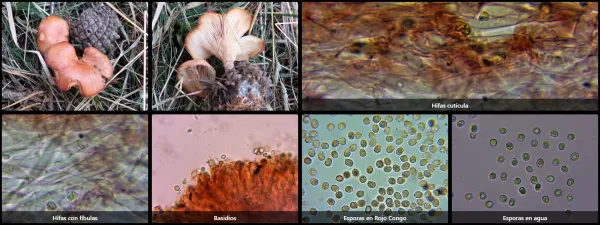

Paralepista flaccida
Taxonomy
Main synonym
Common names
Lepista roja, Klitozibe ezpaingorria, mixarnó.
Geographic references:
Interactive map with data from GBIF.

Morphological Features:
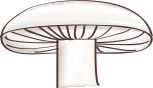
Pileus with an adult diameter ranging from 5 to 10 cm. Initially convex with a depressed or umbilicate center during the early stages of development, it later flattens toward the margin while the center becomes more depressed, eventually becoming distinctly funnel-shaped or infundibuliform. The cuticle exhibits a uniform color across the entire surface, ranging from orange-ochre to reddish-ochre. It is by no means hygrophanous; consequently, the margin lacks striations. The margin is thin in mature specimens and incurved in young ones.
Lamellae clearly decurrent, cream-colored, darkening only when old. Very crowded, with few to no lamellulae, and characteristically easily separable from the pileal flesh.
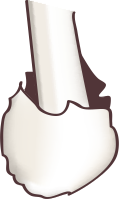
Stipe usually curved or more or less cylindrical, proportional in size to the pileus or slightly shorter. Pale, whitish, or cream-colored, though it may turn dull reddish with age or upon handling. Slightly fibrillose, with a white mycelial base.
Flesh narrow but compact, cream-colored when young, turning reddish-ochre when old. Somewhat elastic and firm, fibrous, particularly in the stipe. Odor mild, between fungoid and herbaceous; raw taste slightly bitter.
Habitat:
A predominantly autumnal fungus that fruits equally under conifers and broadleaf trees. Very common and abundant, typically fruiting in fairy rings or linear groups.
Observations:
Readily recognizable species that exhibits two well-differentiated forms or color morphs depending on its habitat, which were formerly considered distinct species: the reddish forms fruiting under conifers were called Lepista inversa, while the orange-ochre forms under broadleaf trees were termed Lepista flaccida; currently, both taxa are unified under the name Paralepista flaccida. Clitocybe gibba is a somewhat similar species, though it is paler in color and has a conical pileus.