
Panaeolus semiovatus
Taxonomy
Main synonym
Common names
Orribeltz arrautzerdi.
Geographic references:
Interactive map with data from GBIF.
Morphological Features:
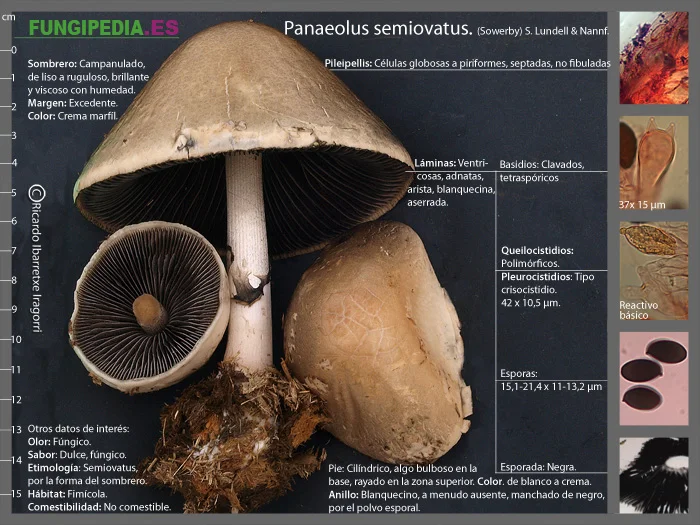
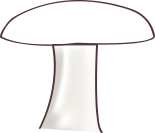
Pileus reaching up to 5 cm in height by 3 cm in diameter at its widest point, initially attached to the stipe and beige in color, but soon expanding to a bell-shaped or more properly semi-ovoid form. The mature color is quite uniform grayish cream, sometimes whitish. Cuticle slightly rugose, glabrous, shiny even in dry weather, rather viscid when wet. The margin may bear remnants of the veil and is not striate.
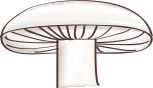
Lamellae adnate, arranged in an ascending manner, ventricose and quite dense. Gray when young, but soon turning blackish.
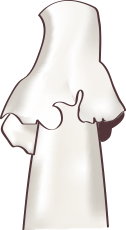
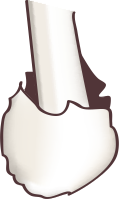
Stipe disproportionately elongated, cylindrical, with a small bulb at the base. Faintly longitudinally striate, somewhat pruinose, and hollow. Its color is similar to that of the pileus, and it bears a fragile whitish ring.
Flesh scant and very thin, whitish to cream-colored. Odor and taste are faint.
Habitat:
Fruits on cattle dung, often growing gregariously. The fruiting season is spring, with appearances also occurring during autumn. It is a very common species.
Observations:
We consider this an unmistakable species, primarily due to its size; it is the largest commonly occurring species in its genus. Its semi-ovoid shape is also diagnostic, as is its uniform coloration, which is lighter than that of other congeneric species. Furthermore, it possesses a ring, making it very difficult to confuse with other habitat-sharing species, such as Panaeolus papilonaceus.
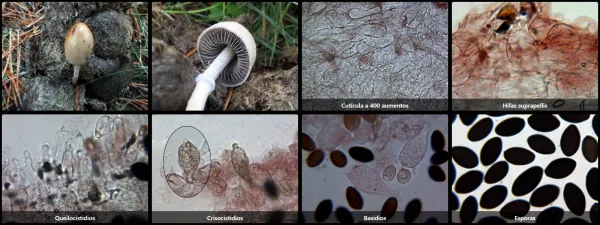
Microscopy of Panaeolus semiovatus