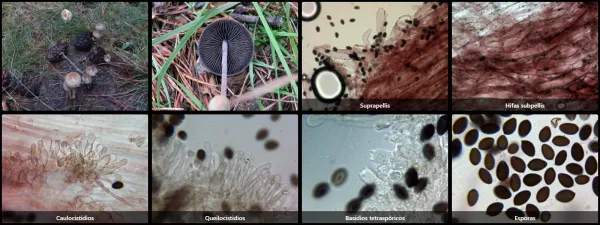

Panaeolus fimicola
Taxonomy
Main synonym
Common names
Not available
Geographic references:
Interactive map with data from GBIF.


Morphological Features:
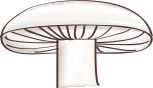
Pileus small-sized, at best barely reaching 3 cm in diameter; initially bell-shaped in early development, but soon becoming convex without ever flattening out. Cuticle smooth and hygrophanous, brown, nearly blackish in older specimens, ochre-grey upon drying, glossy when moist, dull when dry. It may occasionally bear a small umbo, but often lacks it, and the margin is even and thin, with a complete absence of veil remnants.
Lamellae adnate, greyish when young, becoming blackish with spore maturation; relatively crowded, with a whitish lamellar margin.
Stipe cylindrical and elongated, ochre in color, slightly paler than the pileus, with a slight reddish tinge when young. Pruinose near the pileus, striate and fibrillose towards the base; fistulose.
Flesh thin and not very firm, ochre-grey in color; elastic in the stipe. Practically odorless with a mild taste.
Habitat:
A species that appears as early as spring, and can also be found throughout autumn. Typically fruits in gregarious clusters on substrates rich in detritus or organic fertilizer, often directly on dung. It is less common than other related species.
Observations:
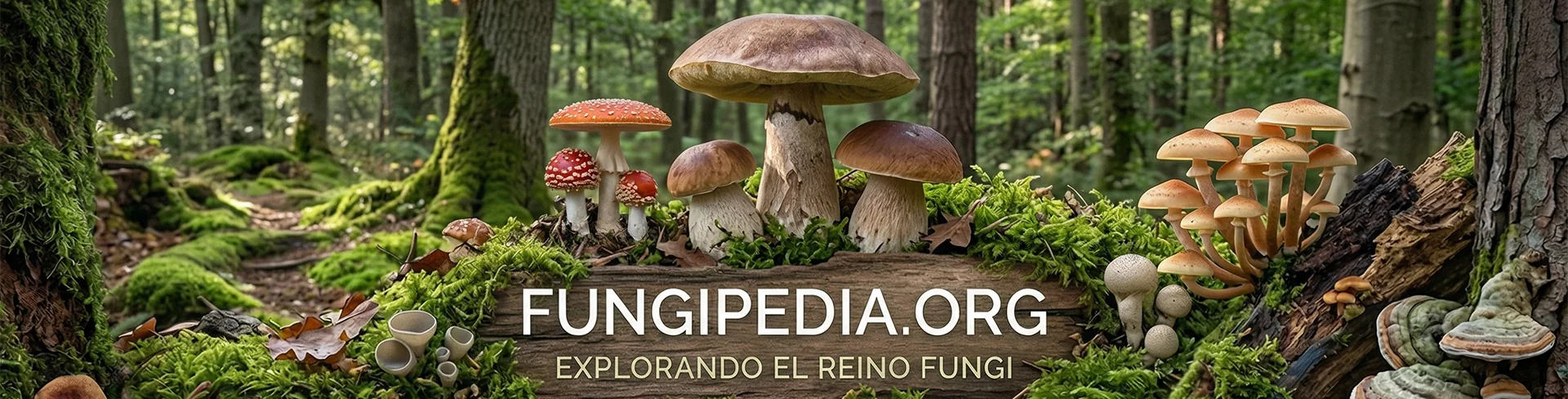
A toxic species, containing substances harmful to the organism, some of which are known as psilocybin, an hallucinogenic compound. There is a very similar species, Panaeolus ater, to the extent that it was once considered synonymous; it shows no major macroscopic differences and even has similar spore dimensions, but can be distinguished microscopically by the presence of cystidia in the latter.