
Orbilia xanthostigma
Taxonomy
Main synonym
Common names
Not available
Geographic references:
Interactive map with data from GBIF.
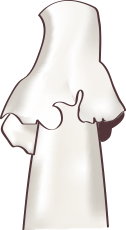
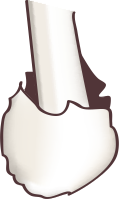
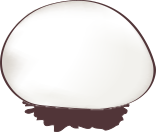
Morphological Features:
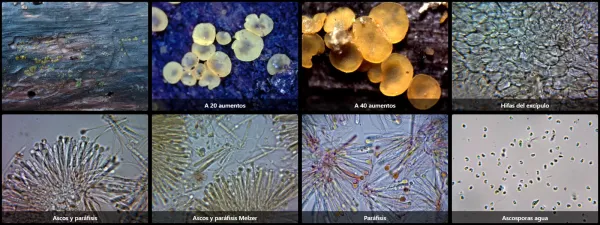
Fruiting bodies sessile, of minute size; a fully developed specimen barely reaches 1.5 mm in diameter. Initially discoid, button-like, with a raised margin, later becoming somewhat convex but open-cup shaped, without narrowing significantly at the upper region. In this final stage, the margin opens and undulates quite irregularly, sometimes folding when clustering with other individuals of its own species or others growing alongside them. The color of the external surface ranges from golden yellow to watery orange.
Hymenium smooth, of a color similar to the external surface; produces very small reniform ascospores, barely reaching 3 µm in length by 1 µm in width.
Stipe absent; attaches directly to the substrate.
Flesh somewhat translucent, orange or yellowish in color, with a waxy consistency. Taste and odor practically imperceptible.
Habitat:
There are references for this species of collections made on various types of wood, both from broadleaf and coniferous trees, ranging from Quercus to Pinus Sylvestris. Our collection was made on alder wood (Alnus glutinosa) in February, in a very humid area. It is evidently lignicolous and, given its small size, difficult to locate; it is also uncommon.
Observations:
The genus Orbilia is macroscopically characterized by its ascomata measuring barely 1 to 2 mm in diameter, with a waxy consistency and a color ranging from whitish-gray to yellow or orange. Microscopically, its asci are characteristic, many of them truncated at the apex and with a base prolonged in a fork or L-shape, as well as its paraphyses inflated at the apex. Recently, studies have emerged asserting that the conidial forms of Orbilia species are capable of trapping nematodes. Orbilia auricolor closely resembles this species, but its size may exceed 2 mm and its spores approach 5 µm.