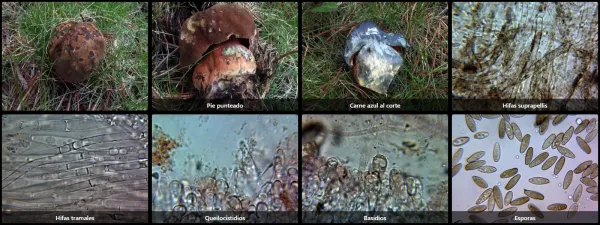
Neoboletus erythropus
Taxonomy
Main synonym
Common names
Not available
Geographic references:
Interactive map with data from GBIF.




Morphological Features:
Pileus 5–15 cm, chrome yellow, staining easily upon touch with a bluish-black hue, turning reddish after about an hour; hard and firm, remaining convex for an extended period, becoming flattened late in development.
Tubes short, bright yellow, staining blue rapidly both upon contact and when cut.
Pores yellow, turning bluish-black at the slightest contact.
Stipe hard, slightly ventricose in the lower portion, tapering towards the pileus; similarly yellow in color, though less conspicuous than the pores, and also staining blue upon touch.
Flesh yellow, staining blue rapidly and intensely upon cutting, reddish at the stipe base.
Habitat:
Although the literature describes it as a species associated with deciduous trees, we consistently find it under Pinus radiata in autumn.
Observations:
Consumption of this species should be avoided due to its rarity, as it is appearing on red lists of protected species in some countries and its edibility is doubtful. It is a beautiful species with uniform yellow coloration, as difficult to find as it is easy to identify. The only species with which it might be confused is Boletus xanthocyaneus (Ramain.) Romagn., especially when young and the pores are yellow. Yellow forms of Boletus erythropus exist with some resemblance.