
Naucoria scolecina
Taxonomy
Main synonym
Common names
Not available
Geographic references:
Interactive map with data from GBIF.
Morphological Features:
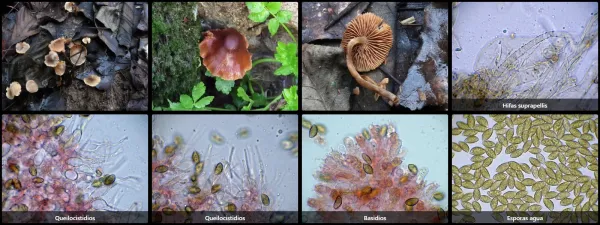
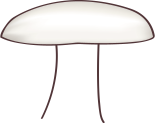
Pileus small in size; the largest specimen observed had a diameter of just over 3 cm, typically between 2 and 2.5 cm, occasionally up to 4 cm. Initially conic at emergence, becoming convex and finally plano-convex. It is a highly hygrophanous species; when very moist, its cuticle exhibits a brown color with reddish tints, more pronounced in the central zone, which may fade to light ochre tones upon dehydration. The margin, generally paler, is radially striate, and depending on its hydration level, it may appear faintly striate or more extensively striate.
Lamellae adnate, ranging in color from light ochre to brown, with numerous lamellulae of varying lengths and rather widely spaced.
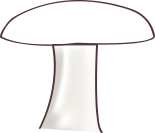
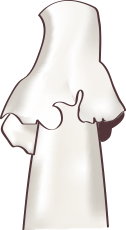
Stipe proportionate to the elongated pileus, cylindrical, covered with white fibrils. It shares a similar color to the pileus, though it darkens from the base towards brownish tones.
Flesh scanty, ochraceous in color, highly hygroscopic; practically odorless with a taste that is at most slightly bitter.
Habitat:
This species is exclusively associated with alders (Alnus sp.). Our collection was made under Alnus glutinosa during spring, though it may also fruit in summer or autumn. It has been found growing gregariously, in groups of numerous individuals on boggy and somewhat sandy ground near a dam and in a flood-prone area. It is not uncommon within its exclusive habitat.
Observations:
There are several small-sized species with similar macroscopic characteristics, associated with alder species or other riparian trees. All are currently under study, and their differentiation relies exclusively on microscopic characters; nevertheless, this separation remains somewhat controversial. Naucoria alnetorum is distinguished by its crowded lamellae and large, verrucose spores. Naucoria striatula may represent a variant of the species presented in this profile; it is described as having long striations, but this is a highly variable and poorly diagnostic character.