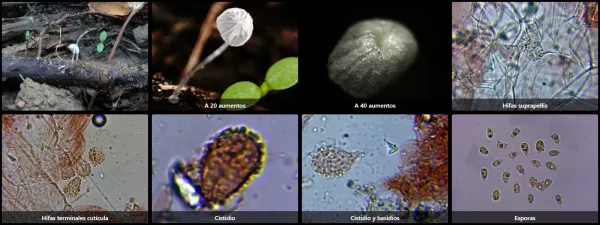
Mycena tenerrima
Taxonomy
Main synonym
Common names
Mycena ascendente.
Geographic references:
Interactive map with data from GBIF.




Morphological Features:
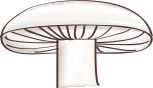
Pileus of minute size, with a diameter ranging from 3 to 5 mm; initially completely hemispherical, then subglobose, a shape it maintains for much of its development, becoming convex late in development and never flattening out. White to grayish-cream in color, with a surface that is entirely striate or nearly sulcate, except perhaps at the center, and markedly furfuraceous. Margin slightly crenulate and fairly regular.
Lamellae adnate-ascending, white, very distant; sometimes slightly short and forming a sort of collar, but this is a variable character and therefore not diagnostic.
Stipe cylindrical and disproportionately elongate relative to the pileus, white, though it can be considered translucent. Its surface may be finely fibrillose, and is always furfuraceous like that of the pileus. Fragile and breaks off immediately with the slightest handling, with a thickening at the point of attachment to the substrate, which is otherwise typical of this type of Mycena.
Flesh completely insignificant, with nothing notable regarding odor and taste.
Habitat:
This is a species that may appear at any time of year, generally associated with woody debris of all kinds, but especially from broadleaf trees. It is a mushroom difficult to locate due to its small size, and should be considered uncommon due to a lack of extensive documentation.
Observations:
It belongs to a somewhat homogeneous group of white Mycena species, and therefore its accurate classification is challenging and requires detailed microscopic analysis. It can be distinguished from Hemimycena species such as Hemimycena lactea or Hemimycena cucullata, which are also white but possess a more rigid stipe that does not break off as easily. However, it closely resembles other species such as Mycena corynephora, which is macroscopically distinguishable only by its villous stipe, or Mycena alphitophora, of subtropical origin, which is very similar to it.