
Mycena corynephora
Taxonomy
Main synonym
Common names
Mycena harinosa.
Geographic references:
Interactive map with data from GBIF.


Morphological Features:
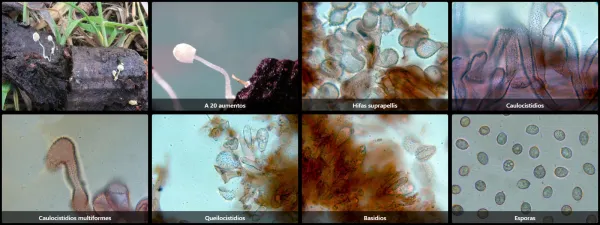
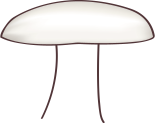
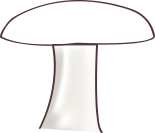
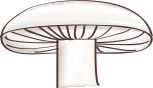
Pileus of very small size; at most, it may reach about 5 mm in diameter. It is campanulate when young, becoming hemispherical, and finally convex, never fully flattening out. Initially grayish-cream in color, later becoming rather whitish, and translucent-striate throughout most of its surface. Its surface is covered with abundant veil remnants, imparting a highly noticeable farinose or pruinose appearance. The margin, somewhat crenulate, is regular initially but tends to become undulate or split with age, and may also bear veil remnants.
Lamellae few in number due to the small size of the basidiocarp and widely spaced; white, adnate to ascending.
Stipe cylindrical and elongated, generally curved, white in color, and slightly thickened at the base. The surface coating is even more pronounced than on the pileus, transitioning from a farinose or pruinose appearance to being practically hirsute. It is fragile, as befits a true Mycena, and often becomes translucent.
Flesh insignificant, with virtually no noteworthy odor or taste.
Habitat:
Fruiting on decaying bark of various broadleaf trees; also found on plant debris. It is a difficult species to locate due to its minute size; it must be considered very rare and poorly documented in the Iberian Peninsula. It may fruit at any time of year provided environmental conditions are suitable.
Observations:
This is a poorly known species, partly due to its minute size but also because of the difficulties in its identification, which necessitates detailed study and the use of a microscope. To the naked eye, the stipe with its nearly pilose coating is striking; however, it closely resembles Mycena tenerrima, as well as other species such as Phloeomana hiemalis, which has a viscid pileus.