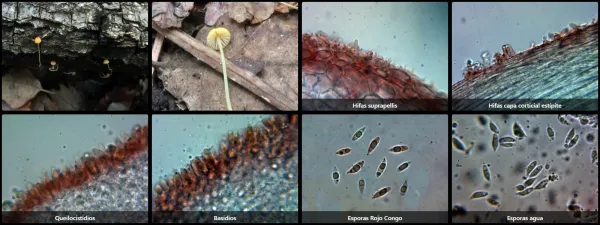

Mycena acicula
Taxonomy
Main synonym
Common names
Not available
Geographic references:
Interactive map with data from GBIF.
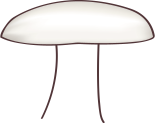
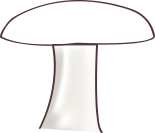


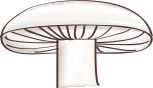
Morphological Features:
Pileus minute in size, merely a few millimeters in less developed specimens, up to 1 cm in diameter at most. Initially conic-campanulate when young, then becoming hemispherical, and finally convex. Surface pruinose and glossy, initially red, turning orange over time, always with a lighter margin, even yellowish in its final stage. The margin is finely striate by transparency and slightly crenulate.
Lamellae adnate and relatively distant from each other, with lamellulae. White in color for much of their development, becoming yellowish at maturity, with the margin of the same color.
Stipe elongated and cylindrical, yellowish in color, translucent, and remaining firm when handled, as is characteristic of Hemimycena species. Slightly pruinose, less so than the pileus in any case, with a whitish mycelial base.
Flesh insignificant due to the small size of the fruitbody, yellowish or translucent in color. We have not detected any appreciable odor or taste.
Habitat:
Various habitats are referenced for this species; it appears capable of fruiting on herbaceous debris or directly on woody remains. Our collection was made on wood of Quercus petraea (sessile oak). It is a somewhat rare species, not too frequent in our immediate surroundings, appearing in autumn.
Observations:
Macroscopically, due to its rigid stipe it might be approximated to the subgenus Hemimycena, but its striking coloration makes confusion with them unthinkable. There is, however, another related species with similarly striking colors, Atheniella adonis, which is much rarer and larger in size. The most common confusion is with Rickenella fibula, which has clearly decurrent lamellae.