
Mutinus caninus
Taxonomy
Main synonym
Common names
Falo perruno, txakur-zakil, fal-lus caní.
Geographic references:
Interactive map with data from GBIF.



Morphological Features:
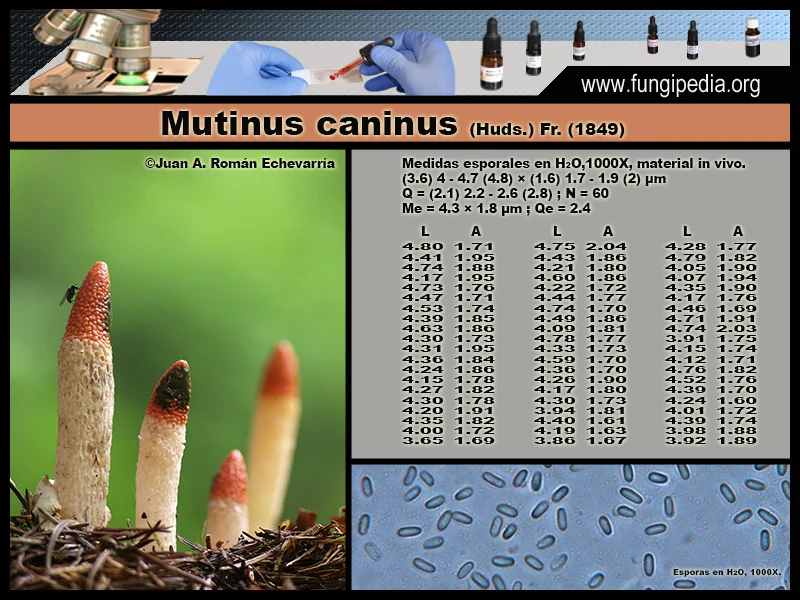
Fruiting body initially formed by a soft, white, egg-shaped receptacle, barely a couple of centimeters in diameter. Upon opening, it gives rise to a stipe terminating in a markedly red apex, but enveloped by the gleba, which is greenish in color and mucilaginous in consistency. This red apex bears numerous small pores visible with a hand lens, through which spores are discharged upon maturation. The entire structure measures barely over half a centimeter in width and no more than 7 to 8 cm in length.
Stipe long and white, gradually adopting orange or yellowish tones with age, hollow and very fragile. Easily separable from the remnants of the egg, which adhere to it like a type of volva.
Flesh insignificant, emitting an unpleasant odor without reaching the stench characteristic of other fungi in its group.
Habitat:
Grows during summer and autumn, sometimes in gregarious clusters, in moist areas of our forests. It is found primarily in beechwoods. It is not as abundant or common as Phallus impudicus.
Observations:
This species is characterized by its small dimensions compared to Phallus impudicus and Phallus hadriani, which additionally lack a red apex. It closely resembles the rare species Mutinus elegans, which is more slender but difficult to differentiate from the species described here.
Microscopy of Mutinus caninus