Mitrula paludosa
Taxonomy
Main synonym
Common names
Mitrula elegante, Mitraxo laranja.
Geographic references:
Interactive map with data from GBIF.





Morphological Features:
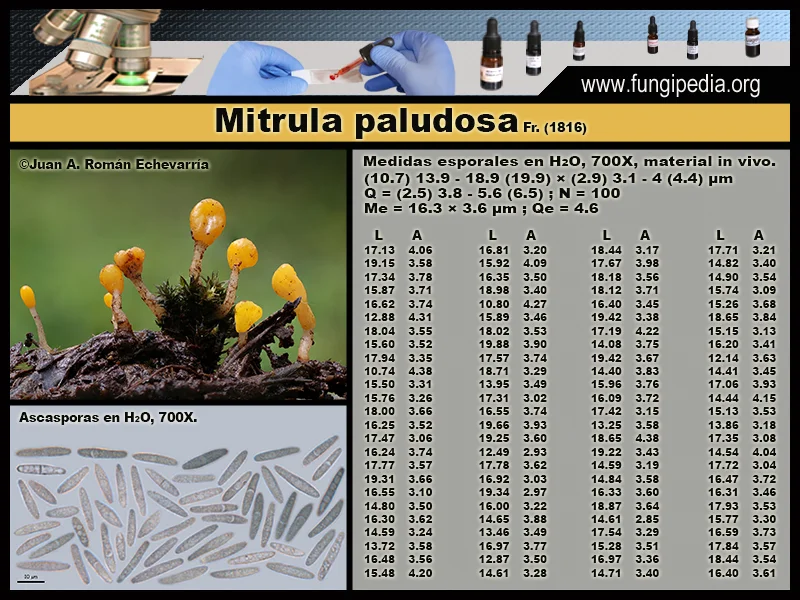
Fruiting body stipitate, with a differentiated club-shaped head up to 1 cm in size, which occasionally assumes a more spherical shape or appears slightly deformed. The head exhibits a bright yellow coloration, shifting to more orange hues upon maturation.
Hymenium embedded within the head of the fruiting body, which is fertile and completely smooth.
Stipe whitish and translucent, 2 to 4 cm long, clearly differentiated from the cap.
Flesh thin, practically nonexistent, fragile.
Habitat:
This rare mycological curiosity is found exclusively during the spring months, and its habitat is highly distinctive, as it typically appears in waterlogged areas, flooded zones, and even in flowing irrigation ditches. This infrequent species emerges from the soil associated with moss or pine needles.
Observations:
This brightly colored fungus lacks culinary value; although not very common, when it appears it does so in large groups. It closely resembles Vibrissea truncorum, which is even smaller and fruits on submerged logs, and due to its habitat it could also be confused with Cudoniella clavus, which also grows on wood, is more whitish, and has a discoid head. The species Mitrula elegans, bearing smaller spores, is described as an American species.
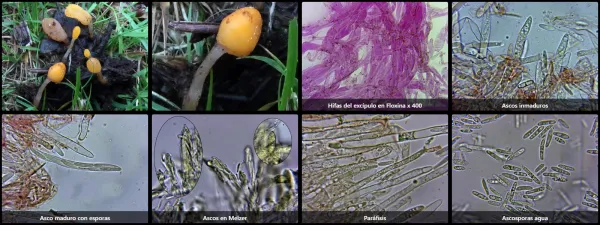
Microscopy of Mitrula paludosa