
Microglossum olivaceum
Taxonomy
Main synonym
Common names
Not available
Geographic references:
Interactive map with data from GBIF.

Morphological Features:
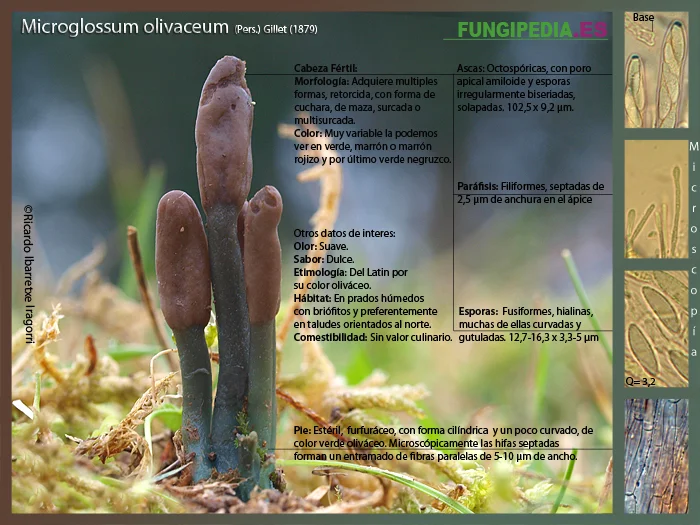
Fruiting body elongated, stipitate, and clavate, composed of two visually distinguishable zones, but not delimited from each other. The total height rarely exceeds 5 cm. The upper part constitutes the fertile zone of the fruiting body, is wider than the stipe, and has a somewhat variable, flattened shape, presenting irregular grooves in many specimens. It is dark brown with clear olive tints, more noticeable in young specimens. It is rather dry or shiny, but not viscid.
Stipe of variable length; in some specimens the stipe is shorter than the head, while in others it is the opposite. It is intensely olive-green when young, somewhat less striking when old, but not reaching the dark color of the head. It is shiny and viscid with rain, otherwise subdry, solid.
Flesh scant and fragile, green in color, with hardly any odor or taste.
Habitat:
Appears in late autumn; the photographed specimens were found in December, among the grass of a meadow at 200 meters above sea level, where a reasonably large group of individuals was located. We consider it a rare and infrequent species.
Observations:
It is a very difficult mushroom to locate, given that it is green and emerges among the grass, which is generally taller than the mushroom itself. Obviously, it holds no culinary value, but does possess mycological interest. There is another species in its genus more well-known than this one, Microglossum viride, greenish throughout the fruiting body, and which has a kind of groove that delimits the head from the stipe.
Microscopy of Microglossum olivaceum