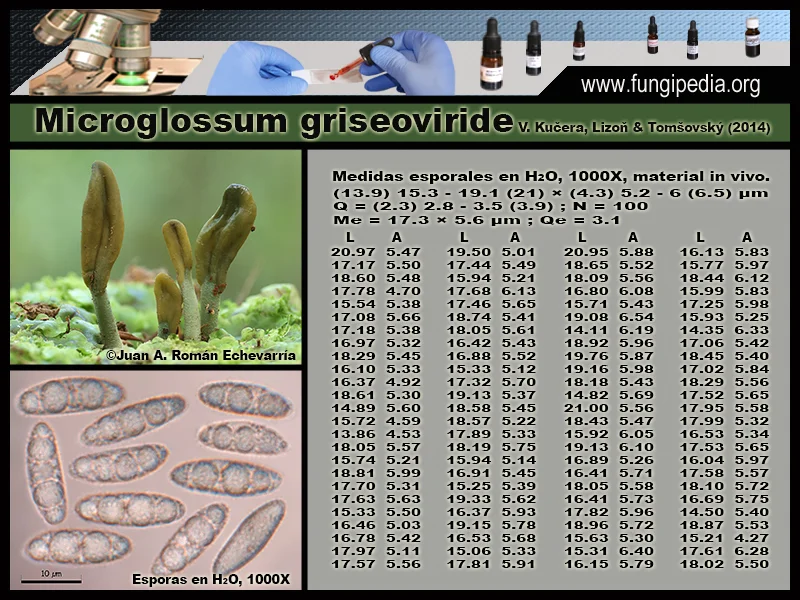
Microglossum griseoviride
Taxonomy
Main synonym
Common names
Not available
Geographic references:
Interactive map with data from GBIF.





Morphological Features:
Fruiting body with a rather slender form, erect in the early stages of development, but frequently developing more curved and sinuous shapes as it matures. It consists of two perfectly delimited parts: an upper zone or clavula (head) and a lower zone or stipe (stem); the boundary between them is not regular but highly variable. The entire structure can reach a height of about 5 cm, and at its widest point approximately 0.6 cm, rarely exceeding 1 cm. It is predominantly green in various shades; the clavula has a more matte tone, sometimes with a grayish tinge, completely smooth and glabrous, often longitudinally split by a groove, though this feature is somewhat variable. It bears a rounded or even flattened apex, and its surface becomes glossy when wet but is by no means viscid.
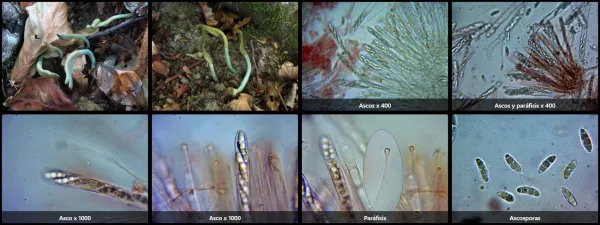
Hymenium exogenous, located on the external surface of the clavula, which is therefore the fertile portion of the fruiting body, while the stipe remains sterile. It produces amyloid, eight-spored asci and elongated spores of considerable size (see microscopic features).
Stipe cylindrical, of length similar to that of the clavula, generally a more striking green than the latter, somewhat pale or turquoise, markedly furfuraceous along its entire length. Solid when young and subsequently pithy, highly homogeneous, without differentiated zones at the base; it is well-differentiated from the clavula but does not detach from it.
Flesh somewhat elastic but ultimately brittle, with no discernible odor or flavor worthy of mention.
Habitat:
A poorly documented and recently described species, for which a preferred habitat under deciduous trees is indicated, without appearing to show a preference for any specific soil type. We first observed it in Gorramendi (Navarre) during a group mycological excursion, under beech trees (Fagus sylvatica), growing in more or less numerous groups. That same year, we located quite a few specimens in the Urkiola Natural Park (Biscay) that we observe annually in the same location and which appear to correspond to this same species, on a mossy slope also near a beech tree. On both occasions, it was found in autumn.
Observations:
The species presented here was differentiated via molecular analysis in 2014. Some authors attempt to distinguish it from the practically identical species Microglossum viride based on subtle microscopic and ecological differences; however, we consider that its separation is only secure through molecular analysis. The presence of the liverwort Pellia epiphylla merely denotes sharing a specific habitat, but if it is not mycorrhizal with it, this fact alone holds no significant relevance for identifying the fungus. In any case, this is a genus currently subject to revision, and will likely lead to the description of new taxa in the near future.
Microscopy of Microglossum griseoviride