Microglossum cyanobasis
Taxonomy
Main synonym
Common names
ninguno
Geographic references:
Interactive map with data from GBIF.





Morphological Features:
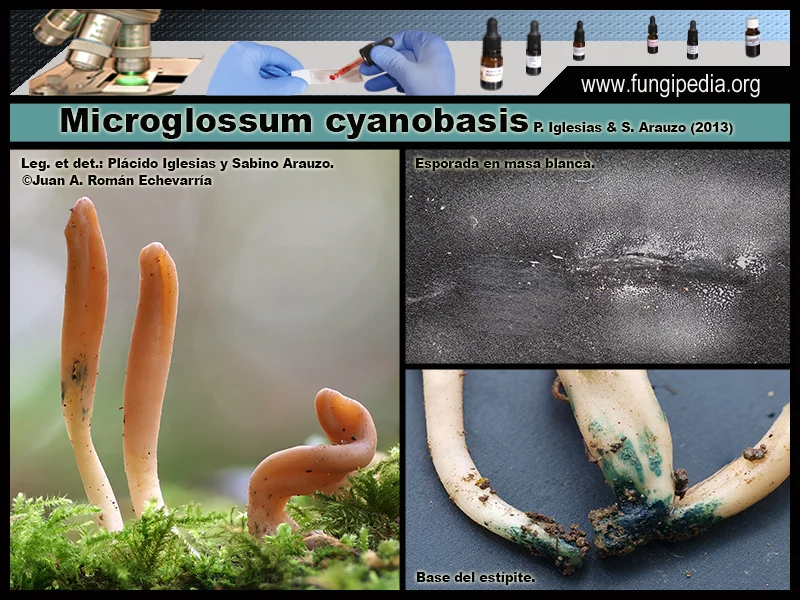
Fruitbody with the typical shape of so-called "earth tongues", slender in most collected specimens, although some exhibit more variable forms, such as twisted ones, with a height ranging from 3 to 6 cm, occasionally slightly taller. It generally has a light ocre color, with an almost translucent appearance, and two perfectly differentiated parts: an upper zone or fertile apex (clavate portion), the fertile part of the fruitbody, which is thicker, sometimes only slightly so, and a lower zone or stipe, distinguishable and with lighter tones. The fertile apex is usually smooth and may become longitudinally fissured only in mature specimens.
Hymenium smooth, located on the upper zone of the fruitbody or fertile apex, light ocre in color, producing amyloid, eight-spored asci with croziers and fusiform spores bearing a guttule (see microscopic features).
Stipe similarly smooth and cylindrical, accounting for up to three-fifths of the total fruitbody height, sterile, generally lighter in color than the fertile zone, sometimes almost whitish, with the base invariably stained bluish-green; occasionally, other parts of it may also take on this coloration.
Flesh scant and fragile, somewhat brittle, without any notable odor or flavor worthy of mention, similar in color to the rest of the fruitbody.
Habitat:
Specimens were located in Oriñón (Cantabria), within the same reference area as the authors of this recently described taxon, Placido Iglesias and Sabino Arauzo, to whom we express our gratitude for enabling us to locate this species, which they described and published as new to science in 2013. It grows gregariously, in small groups, mainly from late autumn to early winter, in humid areas at sea level, associated with Laurus nobilis, Corylus avellana, and Eucaliptus globulus. A rare species and therefore worthy of protection.
Observations:
A recently described taxon, first located by the authors in December 2009 and published four years later. It is characterized as a rather small and fragile species, light ocre in color, and distinguished by the presence of bluish-green stains at the base of the stipe in all specimens. There are some taxa with certain similarities, such as the equally rare Microglossum fuscorubens, a species with more reddish-ocre tones, a darker stipe, and lacking the bluish-green basal stains, in addition to having a fissured fertile apex from an early stage and microscopic differences in the paraphyses and spore size.
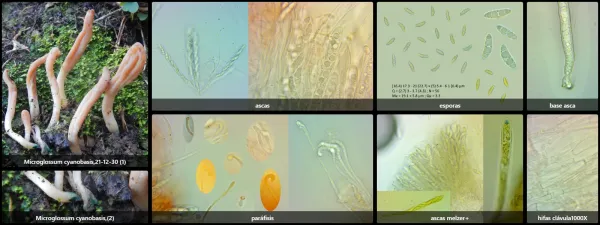
Microscopy of Microglossum cyanobasis