
Meripilus giganteus
Taxonomy
Main synonym
Common names
Poliporo gigante, ardagai erraldoi, gamarús.
Geographic references:
Interactive map with data from GBIF.
Morphological Features:
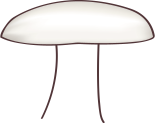
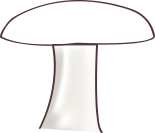
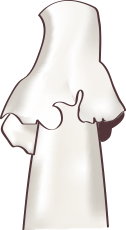
Basidiocarp annual, composed of a succession of overlapping or imbricate pilei, each of which can exceed 25 cm in width by 15 cm in projection. The entire structure can reach up to one meter in width by 50 cm in projection, representing spectacular dimensions. It is light ochre in color with a creamier margin, darkening to brown over time. Its surface is finely velvutinous when young, later becoming glabrous, generally radially wrinkled, and occasionally somewhat concentrically zoned. Margin undulate, rounded at the point of emergence, and thin in fully developed specimens.
Hymenium smooth for most of its development, whitish or cream-colored; small pores appear only late in development, numbering 3 to 5 per mm, ranging from dirty white to dark brownish-black, a coloration adopted with age or handling.
Stipe practically absent; the basidiocarps arise from a common lateral base relative to the pilei.
Flesh fibrous and coriaceous, softer when young and later somewhat harder, but always retaining a certain elasticity. White in color; upon cutting, it occasionally turns reddish and invariably darkens. Odor barely perceptible; taste very mild.
Habitat:
This fungus grows on the wood of broadleaf trees, generally on stumps, although sometimes on standing trees, serving as an unequivocal sign of the tree's death or decline. It is typically found mainly during autumn, being frequent but not abundant in the Iberian Peninsula.
Observations:
The spectacular dimensions of this fungus's basidiocarps, its smooth hymenium that becomes porous only late in development, and the darkening of its flesh upon cutting make it a species easy to identify for any amateur mycologist. There is, however, a form typical of firs classified as Bondarzewia mesenterica, whose basidiocarps do not darken upon drying or cutting. Grifola frondosa and Polyporus umbellatus are smaller species with stipitate basidiocarps.