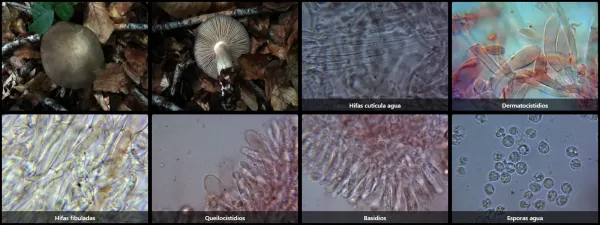
Megacollybia platyphylla
Taxonomy
Main synonym
Common names
Collibia de sombrero estriado, kolibia sustraitsu.
Geographic references:
Interactive map with data from GBIF.




Morphological Features:
Pileus large for its genus, frequently exceeding 10 cm in diameter, hemispherical to convex, and finally flattened. Usually brown with a distinct olive tinge, but highly variable depending on the specimen's hydration level. What remains constant is its clear radial fibrillation, with these fibers being darker than the background. Additionally, it is common to find specimens with a radially cracked cuticle.
Lamellae adnate, whitish in color, widely spaced, thick-fleshed, and broad. When old, they become stained with creamy or ochre tones.
Stipe elongated and smooth, similar in color to the pileus or slightly lighter, likewise fibrillose, cylindrical, or slightly broadened at the base. It is quite robust and features characteristic mycelial cords at its termination.
Flesh very soft and insubstantial, readily absorbing moisture, with no noteworthy odor and a mild taste.
Habitat:
A very frequent and abundant species in broadleaf forests, rarer under pines. It can be found from spring until nearly the onset of winter, and behaves as a saprotroph on decaying woody debris.
Observations:
It is one of those mushrooms you grow tired of seeing when foraging in the woods, and furthermore, it lacks culinary value due to the poor consistency of its flesh. We consider confusion with any other Collybia species unlikely, though not so with certain Pluteus species; however, we must not forget that the latter have a pink spore print, the color to which the lamellae stain upon maturation.