
Mattirolomyces terfezioides
Taxonomy
Main synonym
Common names
Trufa dulce de Hungria, trufa de miel, Homoki szarvasgomba.
Geographic references:
Interactive map with data from GBIF.



Morphological Features:
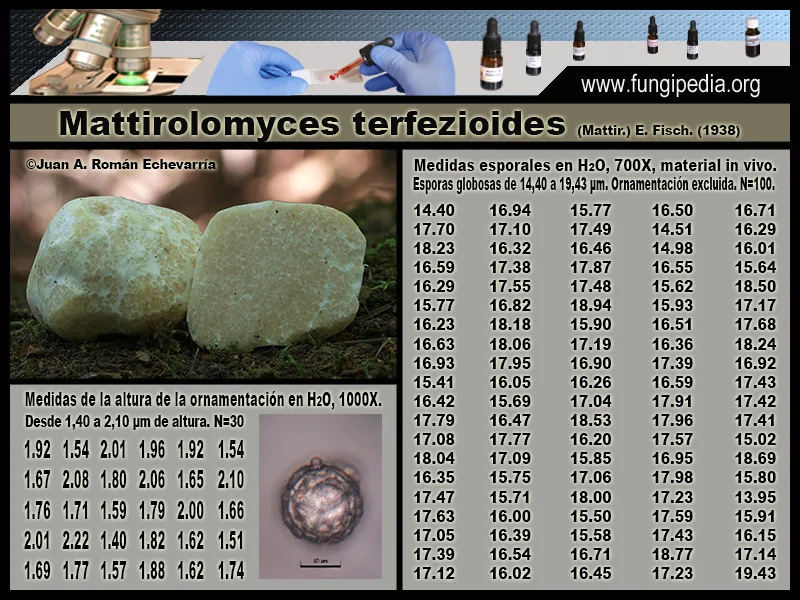
Basidiocarp rarely globose in shape, usually of variable form, more or less oblong but quite irregular, bearing numerous protuberances or fissures which in no case form any type of cavity, but always exhibiting the typical tuberous or potato-like shape common to hypogeous species. It is quite satiny white in color, tending to stain ochre upon handling, and its size is also highly variable; in the specimens studied, ranging between 3 and 8 cm in diameter, although they can occasionally reach considerably larger sizes, even exceeding 15 cm.
Peridium completely smooth and white, which with age tends to turn first cream-colored and then ochraceous when old; it also stains ochre when rubbed. Rather thin and inseparable from the gleba.
Gleba initially compact, remaining so for a considerable time, but in very mature specimens it becomes softer and spongy. Whitish in color during the initial developmental stage, hardly distinguishable from the sterile veins it possesses; later turning more cream-colored and finally ochraceous, with the sterile veins remaining white throughout.
Flesh which is actually nothing other than the gleba itself, compact, with a quite pronounced and sweetish odor characteristic of the species; pleasant, but in excessively mature specimens it becomes so strong as to be unpleasant. The flavor is analogous to the odor, sweetish, and quite different from any hypogeous fungus we have encountered.
Habitat:
The specimens that served as the subject of this study originated from Hungary, where they were located under Robinia pseudoacacia. It is a species that is completely hypogeous when young, but partially emerges to the surface upon maturation, with autumn months being its preferred period of fruiting. Aside from the habitat of our collection, it has also been proliferating in recent years in Spain, specifically in the province of Valencia, associated with orange cultivation (Citrus x sinensis); records also exist from other parts of the world under various fruit trees. It shows a preference for basic soils.
Observations:
This species is characterized by its sweet odor and flavor, its white color that stains upon rubbing, and its white gleba when young. It is a good edible that we have been able to enjoy; its flavor is peculiar and bears no resemblance to that of true truffles or Terfezia species, making it suitable for use in desserts, although it is also good in savory dishes. Caution should be exercised when consuming specimens found in orange groves, given that fungi have the capacity to absorb pesticides used in these crops; they should not be collected unless it is certain that the crop does not use such products. It may be confused with Tirmania nivea, the desert truffle, a choice edible, which has a milder odor and a nutty flavor, as well as with other semi-hypogeous species such as Choiromyces meandriformis, a somewhat toxic species, or Terfezia magnusii, the well-known "criadilla jarera".
Microscopy of Mattirolomyces terfezioides