
Marasmius oreades
Taxonomy
Main synonym
Common names
Senderuela, carrerilla, senderilla.
Geographic references:
Interactive map with data from GBIF.



Morphological Features:
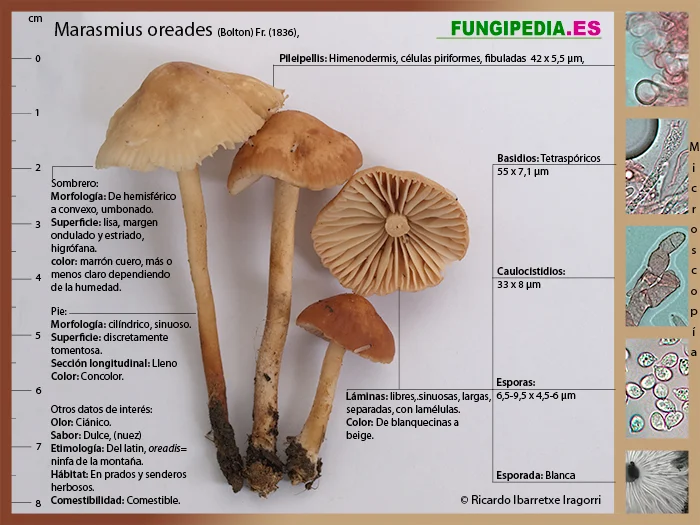
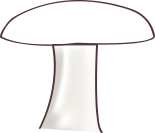
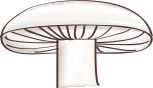
Pileus 2 to 5 (7) cm, initially bell-shaped, then convex and finally expanded, retaining an obtuse umbo at the center. It is hygrophanous, and depending on the degree of hydration, the color varies from dark cream when hydrated to a whitish tone when dry. Margin usually striate.
Lamellae whitish to cream-colored, spaced apart, free or slightly notched, and thick.
Stipe central, cylindrical and quite long, whitish or concolorous with the pileus, with an elastic consistency that allows it to return to its original state without breaking when twisted.
Flesh scant, whitish, with a characteristic pleasant odor and mild taste.
Habitat:
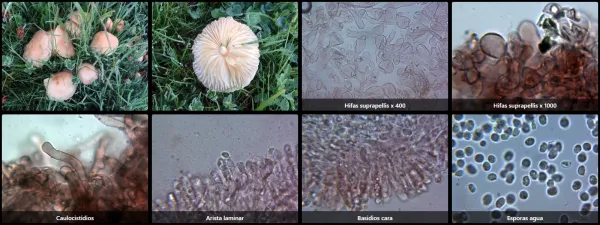
Typically fruits in spring and autumn, forming "fairy rings" or linear arrangements in meadows and grasslands.
Observations:
This species is a good edible with a fine and delicate flavor, provided that only the caps are collected and the stipe is discarded. It may be confused with Marasmius collinus, as their size and color are similar, and they fruit at the same time and in the same habitat; however, the latter has much more crowded lamellae, an unpleasant odor, and its stipe would break if twisted. The toxic species Clitocybe rivulosa shares the habitat, but it has clearly decurrent lamellae and its stipe also does not withstand twisting.

Microscopy of Marasmius oreades