

Marasmius graminum
Taxonomy
Main synonym
Common names
Marasmio de las gramíneas.
Geographic references:
Interactive map with data from GBIF.




Morphological Features:
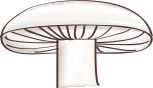
Pileus small-sized; most specimens located barely reached 2 to 3 mm in diameter, with the largest measuring 5 or 6 mm. Upon emergence, it is hemispherical, gradually expanding until becoming umbrella-shaped; even the protrusions caused by the lamellae resemble umbrella ribs. A well-defined umbilicus is apparent at the center of the pileus, persisting from inception throughout its entire development. The surface, initially smooth, becomes rugulose over time; it is reddish-orange when young, later turning more reddish-ochre. Due to the sulcate nature of the pileus, the margin is highly crenulate.
Lamellae whitish to cream-colored, widely spaced, free from the stipe, broad, and somewhat ventricose. Some specimens possess a well-defined collar around the stipe, whereas in others it is barely perceptible.
Stipe elongated and filiform, dark brownish-black throughout almost its entire length, with only the region adjacent to the pileus being slightly lighter.
Flesh scanty and white, tenacious in the stipe, without any noteworthy odor or taste.
Habitat:
This small fungus exhibits a graminicolous habitat, fruiting on the stems of various grasses or on roots; the photographed specimens were found in a grassy area near century-old oaks. We have observed it in July; bibliographically, it is classified as a summer and autumn species. It is rather rare, but when encountered, numerous specimens are invariably found due to its gregarious fruiting habit.
Observations:
There are three species exhibiting certain similarities in color and other characteristics: on one hand, Marasmius armeniacus, which is readily distinguishable by its flattened, non-umbilicate pileus and the absence of a collar. We are less certain regarding Marasmius curreyi, differentiated by some authors as an independent species due to its larger size and shorter stipe; we believe it may actually be conspecific. Cryptomarasmius corbariensis is also described as similar but possesses an exclusive habitat on olive twigs.