
Marasmius collinus
Taxonomy
Main synonym
Common names
Falsa senderuela, marasmio faltsu.
Geographic references:
Interactive map with data from GBIF.

Morphological Features:
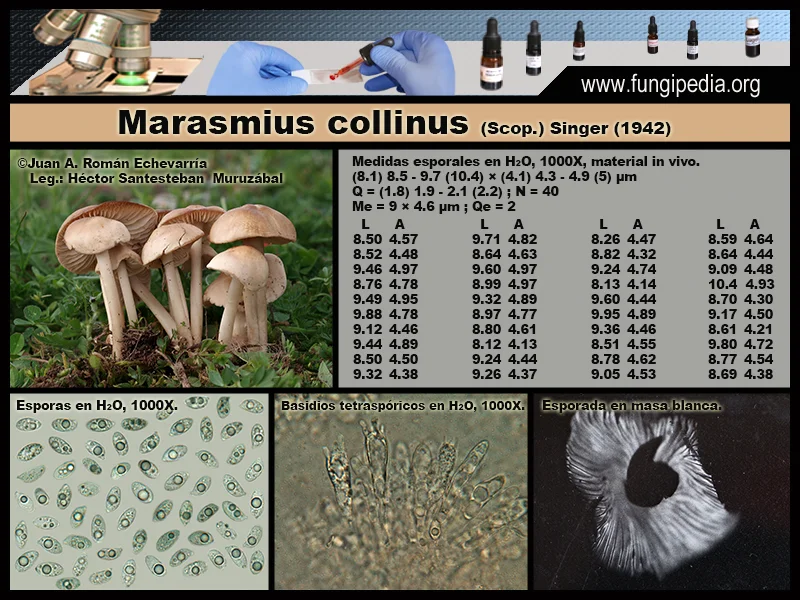
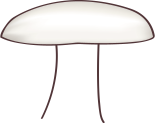
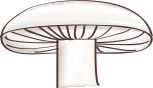
Pileus bell-shaped during the early stages of development, subsequently becoming convex and eventually flattening out almost completely, without ever becoming infundibuliform, retaining a central umbo at this stage. Its diameter typically ranges from 2 to 4 cm, occasionally reaching up to 6 cm. Surface smooth and glabrous, lacking hairs or pubescence, with a color that varies considerably depending on the hydration level of the specimen, ranging from a flesh-toned hue when hydrated, shifting to light ochre or creamy shades as it dries. Margin slightly exsert in mature specimens.
Lamellae free or nearly free from the stipe; in hydrated specimens, lighter in color than the pileus, becoming similar to it upon dehydration, more or less light cream-colored. Moderately spaced apart, wider-spaced than in Collybia dryophila and narrower than in Marasmius oreades, rather thick, with lamellulae.
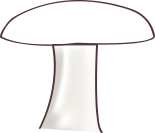
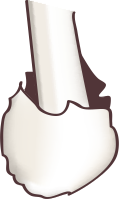
Stipe central and cylindrical, elongated, may exceed 10 cm in length, reaching up to three times the diameter of the pileus, fibrillose, but not highly elastic, splitting and breaking upon twisting. Uniformly almost white in color, with no distinction between the apex and base.
Flesh scanty, very thin, whitish or cream-colored, fragile. Lacks the cyanide-like odor characteristic of Marasmius oreades; its own odor is stronger and unpleasant, and its raw taste is also disagreeable.
Habitat:
Specimens located by Hector Santesteban during an outing conducted by the senior team of Fungipedia, along with the aforementioned individual and Jon Joseba Arnedo, in the Sierra de Cameros (La Rioja), on a mountain meadow at an approximate altitude of 1200 m.a.s.l., in more or less numerous groups, occasionally growing in caespitose clusters. Our collection was made in June, thus in spring, but it is a species that also fruits during autumn. A poorly documented species, likely due to its resemblance to other species with which it is commonly confused.
Observations:
This is a slightly toxic species that bears a striking resemblance to the edible Marasmius oreades, commonly known as the fairy ring mushroom or wood elfin saddle. Two key characters should be considered to differentiate between the two species: the stipe of this species splits when twisted, whereas in Marasmius oreades it remains intact and elastic, and the somewhat unpleasant odor of this species, in contrast to the pleasant cyanide-like scent of the latter. It also resembles the rare Marasmiellus maas-geesteranii, whose stipe darkens from the base upwards. It is also very similar to the elusive Gymnopus oreadoides and the abundant Gymnopus dryophilus, the latter being more typical of woodland habitats, possessing a pleasant odor and a higher density of lamellae.
Microscopy of Marasmius collinus