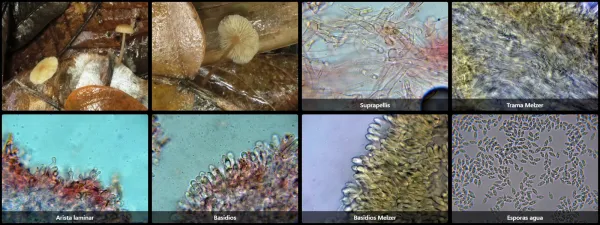

Collybiopsis vaillantii
Taxonomy
Main synonym
Common names
Marasmio de Vaillant.
Geographic references:
Interactive map with data from GBIF.
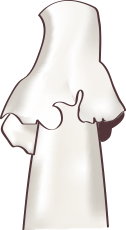
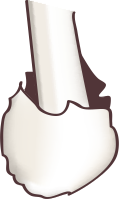
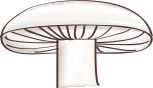
Morphological Features:
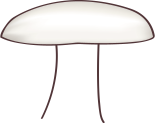
Pileus with a diameter in adult specimens ranging from 0.5 to 1 cm, occasionally slightly larger, with a shape that evolves according to its developmental stage: from hemispherical it becomes convex, then flattened, and even in older specimens it becomes somewhat depressed at the center, leaving the margins uplifted. Its surface is irregularly rugulose, pale cream or whitish in color, often with the center tinged pinkish-ochraceous. Margin slightly undulate.
Lamellae slightly decurrent when young, becoming more decurrent with age, additionally arching gradually as they grow. They are white in color and quite distant from one another.
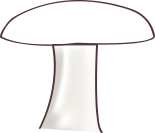
Stipe cylindrical and in most cases curved, uniformly reddish-brown in the lower third, while the area closer to the pileus is lighter. It is very slender and pulverulent, reaching 2 to 3 cm in length by merely 1 mm in thickness.
Flesh White in color and elastic in consistency in the pileus, much tougher in the stipe, thin. It is practically odorless and its taste is also insignificant.
Habitat:
This is a species that appears gregariously, in numerous groups, generally during the summer months, more rarely in autumn. It fruits on various herbaceous remains or residues or grass roots, although it can also fruit directly on the wood of fallen branches. Relatively frequent but little known.
Observations:
This is a small species characterized by its wrinkled cuticle and its fruiting period, as it typically appears in summer. It bears some resemblance to other Marasmiellus, such as Marasmiellus ramealis, with a smooth pileus and an exclusive habitat on fallen branches, or also to Marasmius epiphyllus, which similarly has a rugulose cuticle but fruits on leaves.