
Marasmiellus maas-geesterani
Taxonomy
Main synonym
Common names
Not available
Geographic references:
Interactive map with data from GBIF.
Morphological Features:
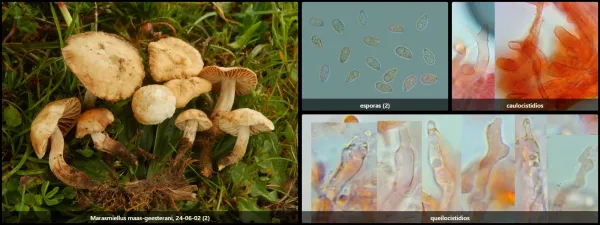
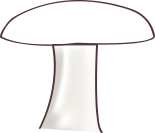
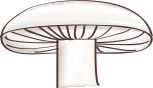
Pileus small in size, but notable compared to other species of the genus; the diameter of mature specimens ranges from 2 to 4 cm. Hemispherical at first, but soon becoming convex and later flattening out. Cuticle dry in appearance even under rain, smooth and glabrous, with a color that varies depending on the age or hydration of the specimen, ranging from more or less light ochre tones to almost whitish, with cream tones of varying intensity predominating in our collection. Margin slightly or not at all striate and involute in young specimens; in older ones, striations may appear, sometimes with a raised relief resembling ribs.
Lamellae adnate and rather distant, not too thick but wide, straight when young and later ventricose, whitish or more commonly cream-colored. Lamellar margin entire and concolorous.
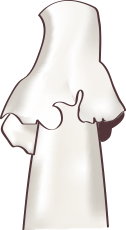
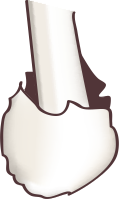
Stipe well-proportioned or somewhat elongated, pruinose, pale in color which persists at the apex, but darkening from the base with ochre, brownish, or even blackish tones on occasion. Cylindrical but tending to taper precisely at the base.
Flesh thin and somewhat fragile, fibrous and rather elastic, especially in the stipe, though it cracks with some ease, cream or light ochre in color. Odor weak and taste slightly herbaceous.
Habitat:
A rare species, very poorly documented, fruiting on various plant residues, both herbaceous and woody. Found by our friend and collaborator Jon Joseba Arnedo in a calcareous pasture with cattle at an altitude between 500 and 600 meters. Despite its rarity, where it occurs it fruits in more or less numerous groups; it was located in May, although we have no confirmation that it is exclusively a spring species.
Observations:
This is a species characterized by its light ochre or cream color common to the entire basidiome, and the darkening of the stipe from the base. A recently described taxon (year 2000), we have found no records of it for the Basque Country nor for the Iberian Peninsula; this could represent a first record. It is very similar to the fairy ring mushroom or Marasmius oreades; we must focus on the stipe to differentiate them. In this species, it darkens and cracks upon twisting, whereas the stipe of Marasmius oreades withstands twisting without breaking. There exists a macroscopically identical and equally rare species, Marasmiellus carneopallidus, distinguishable only by minor microscopic details.
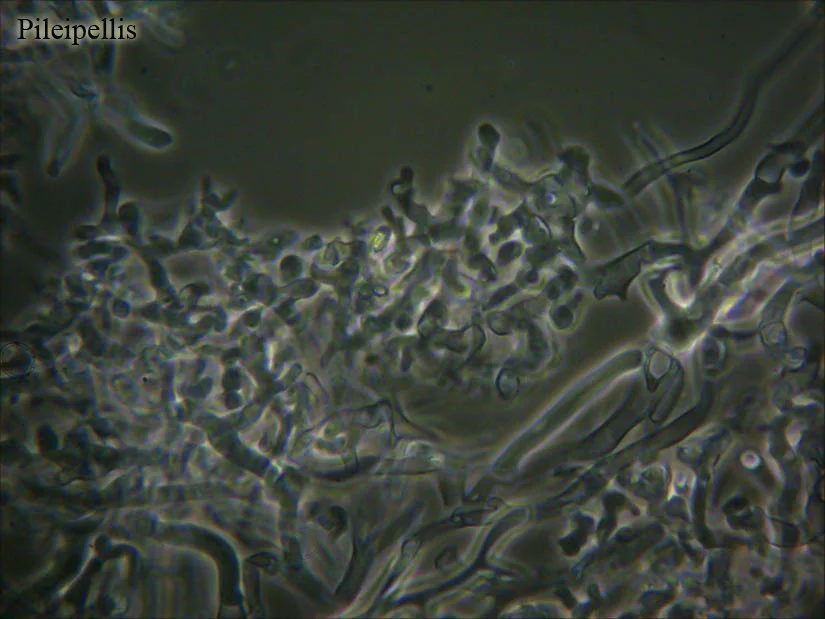
Microscopy of Marasmiellus maas-geesterani