
Marasmiellus candidus
Taxonomy
Main synonym
Common names
Marasmio candido.
Geographic references:
Interactive map with data from GBIF.


Morphological Features:
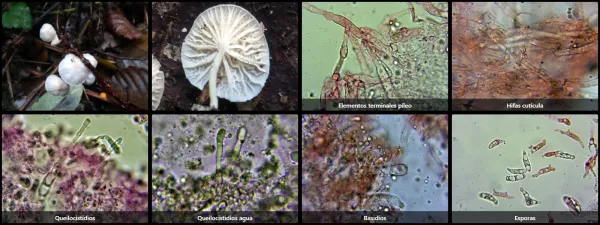
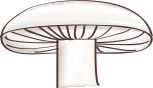
Pileus reaching at most 1.5 (2) cm in diameter; it is most common to find specimens whose diameter approaches one centimeter. Its shape varies with growth, being convex for most of the time, later becoming flattened, possibly with a slight central depression, but rarely fully depressed. The surface appears smooth but rugulose under a hand lens, pure white in younger specimens, while in older ones the center is somewhat darker and may adopt a more creamy tone at this stage. It is translucent, revealing the lamellae beneath and giving a striate or sulcate appearance; the margin is fairly regular and slightly undulate in older individuals.
Lamellae adnate to subdecurrent, very distant, white with a waxy appearance, often plicate and anastomosing, interconnected by irregular veins. They do not form a collarium.
Stipe generally shorter than the pileus diameter in adult specimens, cylindrical and incurved; initially white, it gradually darkens from the base upwards, first taking on greyish tones and later becoming blackish, with only the apex retaining its white color in older specimens.
Flesh white and insignificant, somewhat elastic in the pileus and slightly more fibrous in the stipe. It is practically odorless and lacks any notable taste.
Habitat:
This species may appear almost year-round under favorable conditions, being as frequent or even more so than other species of its genus, although it may go unnoticed due to its small size. It typically grows in relatively large clusters on fallen branches or woody debris in general; we have located it on brambles, oak remains, beech wood, etc.
Observations:
This small species is characterized by its pure white color, very distant lamellae, and a stipe that darkens from the base. Marasmiellus ramealis is similar, sharing a habitat on woody debris, but its pileus exhibits ochre or pinkish tones, its spores are smaller, and it lacks lageniform cheilocystidia. Hydropus omphaliiformis has an elongated stipe and decurrent lamellae; some Marasmius species, such as Marasmius epiphylloides, also resemble it. Delicatula integrella, with its plicate lamellae, is similarly alike, but its stipe does not darken with age.