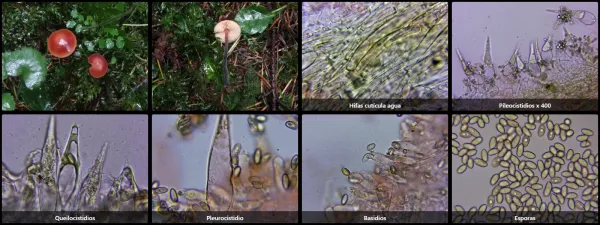

Macrocystidia cucumis
Taxonomy
Main synonym
Common names
Seta con olor a pepino, arrain-ziza.
Geographic references:
Interactive map with data from GBIF.



Morphological Features:
Pileus small in size, rarely exceeding 5 cm in diameter at full maturity. Initially conic-campanulate, it gradually expands to become plane, sometimes becoming umbonate or not, a variable character. The cuticle is glossy during rainy periods, subdry and pruinose under other conditions. It exhibits a characteristic reddish-brown color, especially in young specimens, though somewhat more variable in mature ones; however, the margin always remains lighter, pale ochre to yellowish. This margin is thin and regular, lacking striations in younger specimens, becoming slightly striate only when old, although this trait is also variable, and some individual specimens may be more distinctly striate.
Lamellae subfree, not very crowded, with abundant lamellulae, ventricose. Initially pale in color, soon becoming ochre with a pinkish or flesh-colored tinge.
Stipe elongated and velvety when young, fistulose, and easily separable from the pileus. Generally brown in color, lighter at the point of attachment to the pileus, and practically blackish towards the base.
Flesh scant and thin, quite fragile, dark ochraceous in color. Its odor upon collection resembles cucumber, but mature specimens and those kept for some time develop a distinctly fishy odor; the taste is also cucumber-like.
Habitat:
This is an infrequent species that typically fruits in moist areas of various forests, both coniferous and broadleaf. Despite its scarcity, when it appears it usually does so not as isolated individuals but in small groups of a few specimens, with late autumn to early winter being its preferred fruiting season.
Observations:
This is a well-characterized species distinguished by its reddish-brown pileus with a lighter margin and its characteristic cucumber odor that later turns fishy. These traits make it difficult to confuse, warranting the establishment of its own genus, which alludes to its taxonomic uncertainty and its large cystidia. It might potentially be confused based on the stipe with Flammulina velutipes var. velutipes, but the latter exhibits a more lignicolous habit, fruits in clusters, and its lamellae do not adopt pinkish or flesh-colored hues, remaining paler instead.