

Lysurus periphragmoides
Taxonomy
Main synonym
Common names
Not available
Geographic references:
Interactive map with data from GBIF.




Morphological Features:
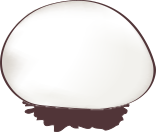
Basidiocarp initially appearing as a dirty-white egg measuring between 3 and 5 cm, with an inner layer of gelatinous consistency. Over time, the egg opens to reveal a pale scarlet-red stipe, which can reach a considerable height, frequently exceeding 10 cm. At the upper region, a distinct reticulate structure is present, darker red or vivid orange in color, with a somewhat flattened apex. This reticulate head generally has a diameter that does not exceed 3 cm. Remnants of the initial egg remain attached to the base, resembling a volva.
Gleba olive-green, embedded within the inner surface of the reticulate region, though it frequently extends beyond the reticulum itself, becoming more conspicuous. It emits an unpleasant fetid odor that attracts flies, thereby facilitating spore dispersal. Its non-amyloid spores are brown in mass and very small.
Stipe elongated, with a porous consistency, hollow. It may occasionally be yellow rather than red; these yellow forms have been classified on multiple occasions as Simblum texense.
Flesh soft and fragile, reddish in color. Its nauseating odor is readily perceptible once the egg opens.
Habitat:
Fruiting solitary or rarely gregarious, in woodland clearings, nitrogen-rich areas, on the ground. This is a species of American distribution; it has been recorded across much of the continent, from Argentina to several states in North America, with no confirmed records from Europe. We present this specimen thanks to the collaboration of Nico Rocca.
Observations:
This is a fungus with a striking shape and equally vivid coloration, emitting a somewhat unpleasant odor. Its initial Pan-American distribution has expanded to virtually the entire continent, becoming increasingly abundant in recent years. Given its peculiar characteristics, confusion with other species is unlikely; in Europe, only one Phallus species shares this coloration, Phallus rubicundus, but it terminates in a simple, non-reticulate gleba.