
Bovistella utriformis
Taxonomy
Main synonym
Common names
Bejín areolado.
Geographic references:
Interactive map with data from GBIF.




Morphological Features:
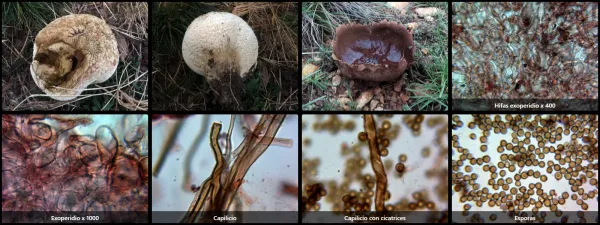
Basidiocarp that can reach 15 cm in width and over 10 cm in height, with a convex or globose upper portion, tapering towards the base, which is sterile.
Exoperidium comprising the outer layer of the fruiting body, is simple, white when young and tomentose in texture, though it cracks to form pyramid-shaped warts that reveal the darker inner layer.
Endoperidium slightly darker, gradually turns grey and encloses the gleba within; it ruptures irregularly to release the spores.
Gleba initially white and firm, though it softens over time becoming spongy and yellowish-green, later turning brown. Upon complete dispersal, a brown remnant persists.
Habitat:
Found equally in spring and autumn, in mountain meadows, heathlands, and clearings within pine forests; it is a very frequent and abundant species.
Observations:
Edible when young and the gleba is still white, although its culinary quality is limited. It is by far the largest of the so-called "wolf's farts" (puffballs), with the exception of Calvatia gigantea, which can weigh up to 25 kg. Calvatia cyathiformis has a violet gleba upon maturity and is the species most closely resembling the one described here.