
Lycoperdon perlatum
Taxonomy
Main synonym
Common names
Cuesco de lobo, bejín, astaputz perladun, pet de llop (perlat).
Geographic references:
Interactive map with data from GBIF.

Morphological Features:
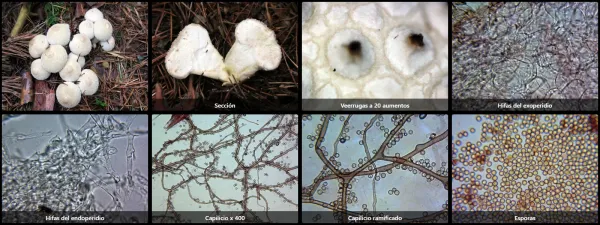
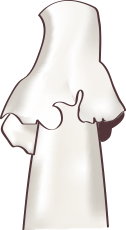
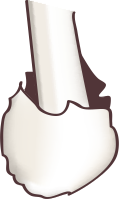
Basidiocarp pear-shaped or lightbulb-shaped, reaching heights that may exceed 5 cm, with an upper width of about 3 to 4 cm. Uniformly white when young, turning greyish or brownish with age. The entire thickened upper region is fertile, while the lower portion is narrower and sterile.
Exoperidium white, becoming greyish with age, simple, covered by a series of warty, concolorous prominences crowned by spine-like projections, giving the whole structure a pearly appearance. With age and exposure to rain, these spines gradually detach from the exoperidium, leaving it smooth with marks where the spines were attached. Eventually, the entire exoperidium sloughs off.
Endoperidium whitish and nearly smooth, though it typically bears irregularly reticulate marks left by the exoperidium. Dehiscence occurs at the apex, where a small opening known as an apical pore forms, through which spores are released into the air.
Gleba spongy and white in young specimens; upon maturation, it first turns yellowish, then greenish, and finally yellowish-brown. The lower region contains sterile gleba or subgleba, ranging from white to olive-brown.
Habitat:
A very common species in our forests, showing no particular preference for a specific type of tree cover, fruiting equally under conifers and broadleaf trees. Fruiting bodies appear singly or occasionally in clustered groups, beginning to emerge in spring, though they are most abundant during autumn.
Observations:
One of the most common species popularly known as "puffballs" in our region, characterized by its white color when young and its covering of "pearls". According to some monographs, it is edible when young, while the gleba is still white, but it truly lacks significant culinary value. It bears a strong resemblance to some of its congeners; Lycoperdon pyriforme fruits in broadleaf forests, often in clusters of numerous individuals, and is smaller. When mature, it may be confused with others such as Lycoperdon umbrinum, which is ochre-colored and bears short spines.