
Lycoperdon echinatum
Taxonomy
Main synonym
Common names
Pedo de lobo, bejín erizado, trikuputz, pet de llop d´agulletes.
Geographic references:
Interactive map with data from GBIF.

Morphological Features:
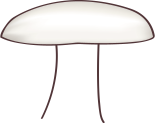
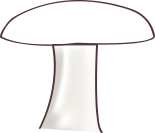
Basidiocarp pear-shaped or lightbulb-shaped, occasionally appearing practically globose. Its height may slightly exceed 5 cm, and its width is similar or slightly less. The upper region is fertile, globose, and ochre in color, somewhat creamy when young and nearly brown when the specimen is old, whereas the lower region, generally narrower, although of the same color, is nonetheless sterile.
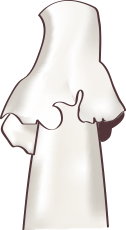
Exoperidium whitish to ochre, entirely covered with spines resembling those of hedgehogs, ochraceous in color. These spines may exceed 5 mm in length, detach with extreme ease upon mere contact, and form a pyramidal arrangement by joining together. Over time, they detach, revealing the endoperidium beneath.
Endoperidium whitish, bearing impressions caused by the detachment of the exoperidium and its spines. Dehiscence occurs at the upper region or apex, through which the spores are released upon maturity.
Gleba initially whitish and spongy, becoming brown and powdery with spore maturation. It features a sterile, spongy subgleba in the lower region of similar coloration, although it may acquire a lilac tint when old.
Habitat:
A very rare species under conifers; we have consistently located it beneath various broadleaf trees, particularly Fagus and Quercus. Nevertheless, even in this habitat, it is not an overly frequent or abundant species. It is primarily an autumnal species, although it may appear sporadically at other times of the year.
Observations:
When young, with its spines intact, it is a practically unmistakable species; however, as these detach so easily, confusion with other species of the genus is possible. The most similar is Lycoperdon nigrescens= Lycoperdon foetidum, a species with an unpleasant odor and a more yellowish gleba featuring cavities in the subgleba. Lycoperdon umbrinum also shares certain similarities, but its spines are much shorter and it has a distinctly brown coloration.