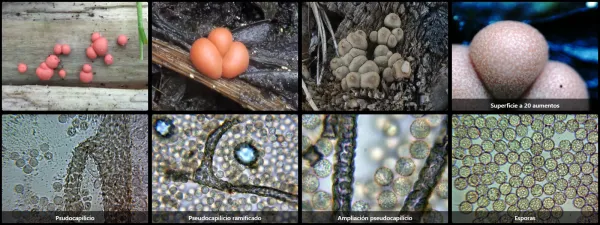
Lycogala epidendrum
Taxonomy
Main synonym
Common names
Not available
Geographic references:
Interactive map with data from GBIF.





Morphological Features:
Plasmodium formed by multiple veinlets that intertwine and harden under certain conditions, forming a compact scarlet-red mass upon which the fruiting bodies of the species develop.
Aethalia, the term used for this type of fructification, are strikingly pink when young, later turning reddish, and finally becoming a matte clay-ochre color. They appear as individually developing spheres, sometimes interconnected but not fused together. Their surface is entirely covered by protuberances visible with a hand lens, which eventually form a kind of crust around them.
Stipe absent.
Flesh does not exist as such; the interior contains, when young, a reddish mass with pinkish tones. Upon maturation, it becomes a brown powdery mass. No odor is detected.
Habitat:
This species is frequently encountered within our survey area; it is observed annually on decaying conifer wood. It can be found from spring through late autumn.
Observations:
Species belonging to the order Liceales, a highly variable group characterized by the absence of calcium carbonate and the formation of phaneroplasmodia. In the plasmodial phase, it may be confused with Tubifera ferruginosa; however, the latter does not develop true aethalia. In reality, these pink spheres growing on wood are virtually unmistakable.