
Loweomyces fractipes
Taxonomy
Main synonym
Common names
Not available
Geographic references:
Interactive map with data from GBIF.
Morphological Features:
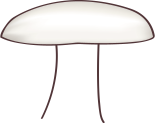
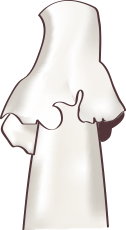
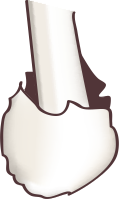
Pileus small in size though variable, its diameter can range from 1 to 4 cm, with a thickness at its widest point that may approach 5 mm, dimidiate, fan-shaped or reniform, although it often adopts imperfect and irregular shapes. The surface is white, which over time tends to take on ochraceous tones in patches until becoming more distinctly ochraceous in age; finely tomentose in the early stages of development, eventually becoming glabrate, weakly or not at all zoned. The margin is rounded in young specimens and thin at maturity, somewhat irregular in age.
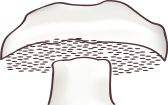
Hymenium composed of very short tubes, no more than 3 mm in length, and small angular pores, numbering between 3 and 5 per millimeter depending on the specimen's age, widening slightly in maturity. Both tubes and pores are white during much of the development, later turning a dirty cream color; furthermore, they are decurrent on the stipe.
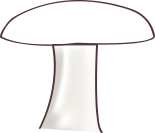
Stipe very prominent, a distinguishing feature relative to similar species; it can occasionally be long, approaching 5 cm, whereas in other specimens it barely reaches 1 or 2 cm. Like the rest of the basidiome, it is white and tends to discolor with age from the base upwards to light ochraceous tones. It is usually thickened at the apex and attenuated towards the base.
Flesh white, only becoming ochraceous in age; slightly elastic when young and later rigid, with two differentiated layers, an inner one much more coriaceous and an outer one softer. No notable taste or odor is detected.
Habitat:
This is a species that should be considered rare or uncommon in Europe and only proliferates in the northern part of the American continent. A specific habitat on dead wood of riparian trees is referenced for it; it is clearly lignicolous and saprotrophic, causing white rot in wood. Our collection was made on alder wood (Alnus glutinosa); despite its rarity in the alder woodland we frequent, it is an abundant species, especially in autumn, though it may also appear at other times of the year.
Observations:
The species presented here is characterized by the white coloration common to the entire basidiome, by being a lignicolous species with a very prominent stipe that is occasionally long, and by its habitat under riparian trees. It bears many similarities to Abortiporus biennis, a lignicolous species with a stipe, but its hymenium is formed by toothed labyrinthine pores, whereas the species described here possesses normal angular pores. Were it not for the stipe, it also closely resembles species of the genera Spongipellis, Postia, or Tyromyces; in fact, it was once classified within one of them.