

Zhuliangomyces illinitus
Taxonomy
Main synonym
Common names
Limacella babosa.
Geographic references:
Interactive map with data from GBIF.


Morphological Features:
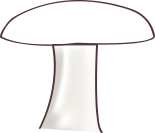
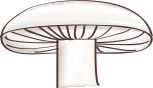
Pileus exceeding 5 cm in diameter in fully developed specimens, initially campanulate, subsequently convex or, at most, plano-convex, without ever becoming completely effaced. The central region is gibbous, eventually developing into a persistent obtuse umbo. The surface is white to pale cream, slightly darker centrally, and entirely enveloped by a viscid coating that frequently persists as a marginal flap. Cuticle smooth and glabrous, with an involute and regular margin.
Lamellae free from the stipe, white, fairly crowded, and somewhat waxy.
Stipe cylindrical and elongate, concolorous with the pileus. The upper third is not particularly viscid but rather pruinose; at this level, it bears a thickening that remains adpressed with a mucilaginous consistency, resembling an annulus. From this pseudo-annulus down to the base, it is equally viscid as the pileus.
Flesh thin and white, with a faint odor and mild taste.
Habitat:
A species fruiting under both broadleaf and coniferous trees; among the former, it shows a predilection for holm oak woodlands, and among the latter, for pine stands. It occurs at moderate to higher elevations and is absent from lowland areas. An uncommon autumnal species.
Observations:
Although some literature suggests it may be edible, its viscid coating hardly invites consumption. The genus Limacella belongs to the same family as Amanita species; they are characterized by a viscid cuticle and the absence of a volva. Specimens collected following dry periods might be confused with Lepiota erminea or Leucoagaricus leucothites, but rehydration of the pileus readily resolves any uncertainty.