
Leucocortinarius bulbiger
Taxonomy
Main synonym
Common names
Cortinario de láminas blancas
Geographic references:
Interactive map with data from GBIF.

Morphological Features:
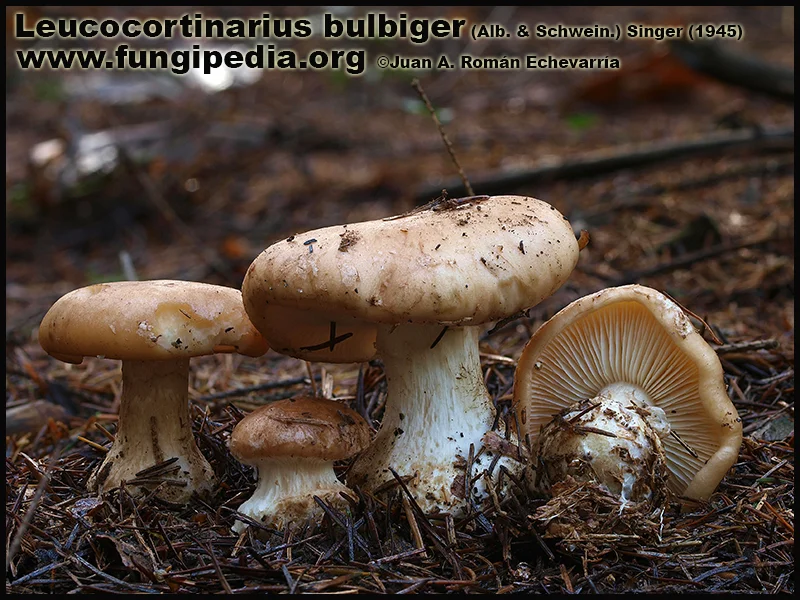
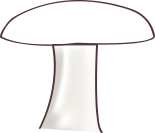
Pileus with a diameter ranging from 5 to 10 cm in mature specimens, hemispherical in the initial developmental stage, soon becoming convex and finally quite flattened, typically bearing a slightly pronounced obtuse umbo. The cuticle is slightly viscid when wet but tends to dry out, predominantly ochre in color, with some orange tints toward the center and fading to beige tones at the margin. The surface is smooth in developed individuals and somewhat more scaly when young, especially toward the margin, which may exhibit floccose patches in early stages. This margin is incurved initially and later becomes straight.
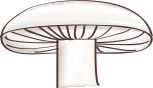
Lamellae generally adnexed, though often with a slight tooth of attachment to the stipe, white for most of their development, only darkening to creamy tones in age. Somewhat crowded when young and loosely spaced in maturity, with few lamellulae or practically none near the point of attachment.
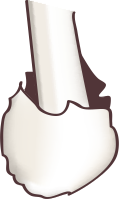
Stipe solid and cylindrical, fleshy, whitish in color and proportionate to the pileus, with a fibrillose appearance. It bears a persistent and conspicuous white cortina in the upper region that connects the stipe to the pileal margin in young specimens; at the base, it possesses a distinct, marginated, concolorous bulb.
Flesh thick and firm, whitish to creamy in color and unchanging upon cutting, with an insignificant odor and a sweet taste.
Habitat:
A species associated with conifers, somewhat rarer in other habitats; we frequently observe it in mixed forests of Pseudotsuga menziesii and Picea abies, although it is also being found under oaks or larches. Despite being a somewhat rare and localized species, we have noted a proliferation of it in recent years. It grows primarily during autumn in small groups or solitarily.
Observations:
Considered edible by some authors, we do not recommend collecting it for this purpose due to its rarity and low culinary value. This species has an uncertain taxonomic position; its white spore print separates it from the genus Cortinarius, whose species generally have ochre or dark spore prints. However, its morphology and the evident presence of a cortina give it a striking resemblance to that genus. Cortinarius multiformis is its closest relative; it even has white lamellae when young, but its en masse spore print is ochre, as befits a true Cortinarius, not white. In general, all Cortinarius species in that subsection share certain similarities with the species described here.
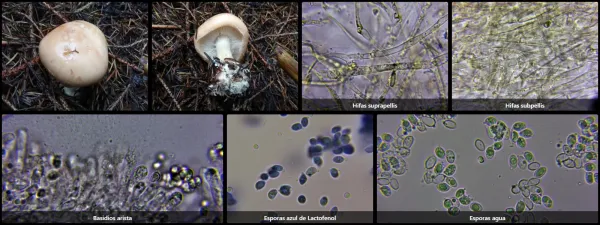
Microscopy of Leucocortinarius bulbiger