
Leucoagaricus badhamii
Taxonomy
Main synonym
Common names
Galanperna faltsu.
Geographic references:
Interactive map with data from GBIF.
Morphological Features:
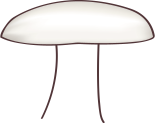
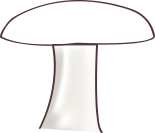
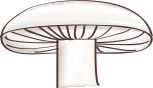
Pileus of substantial size; adult specimens readily exceed 10 cm in diameter, occasionally approaching 20 cm. Initially trapezoidal and helmet-shaped when young, with a flattened apex, later expanding to nearly flat while retaining a somewhat depressed umbo. Cream-colored background covered with brownish scales bearing a purplish tinge that extend over the entire surface, being more densely packed at the center. Margin typically fissured in older specimens; bruises to yellowish tones upon handling, which subsequently turn reddish-brown or purplish.
Lamellae subfree, collar-like, crowded, unequal, and broad; cream-colored, but becoming unattractive and dirty-looking, turning ochraceous with age.
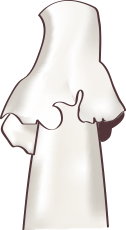
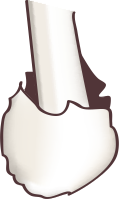
Stipe whitish upon emergence, but rapidly staining brownish, yellowish, or reddish. Generally curved and amorphous in outline, with characteristic thickenings in the central region. Proportional in size to the pileus; usually bears a ring, though it is not uncommon for it to be lost.
Flesh relatively thick and white, fibrous in the stipe. Upon cutting, bruises yellowish before turning reddish. Odor fungoid; taste sweet, slightly acidulous. Green reaction with ammonia.
Habitat:
Found in areas with decomposing organic matter, nutrient-rich soils, rotten wood, or sawdust; generally in ruderal zones, though it can also be encountered on decaying wood of old trees in woodland areas. A very rare and scarce species, though when fruiting it typically appears in groups. Fruiting season is primarily summer to early autumn.
Observations:
This species is characterized by the generalized reddening of the entire fruiting body upon the slightest handling, a feature that aids in distinguishing it from similar taxa. Among these are Leucoagaricus pilatianus, a smaller mushroom with a uniformly vinaceous pileus; Leucoagaricus purpureolilacinus, which has a viscid pileus; or Leucoagaricus americanus, the most similar of all, which possesses slightly yellowish lamellae.