Lepista sordida
Taxonomy
Main synonym
Common names
Pie azul sordido, ziza ahul ankaurdina.
Geographic references:
Interactive map with data from GBIF.




Morphological Features:
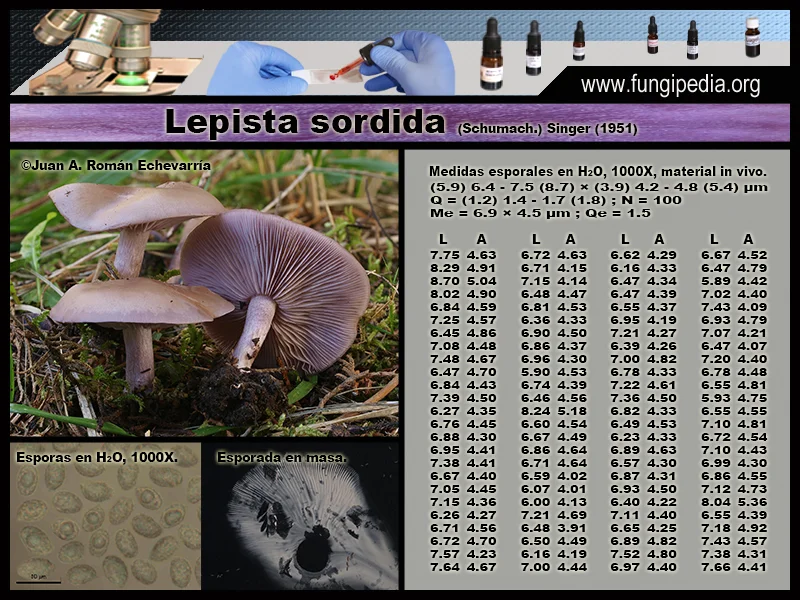
Pileus rather small in size for the genus; the diameter of mature specimens generally does not exceed 6 to 8 cm, and is even smaller in var. lilacea. Initially hemispherical, soon becoming convex and finally flattened; it rarely becomes infundibuliform. In many specimens, the center is somewhat obtusely raised, without an acute mamelon or umbo. The cuticle is smooth, appears moist, and is separable. Its color is highly variable due to strong hygrophanous properties, typically a vivid lilac that fades to ochre or cream tones but always retains a faint lilaceous tinge. The margin is usually translucent, regular when young and later undulate; it may or may not be striate depending on the specimen's moisture content, occasionally revealing the lamellae through translucency.
Lamellae adnate to subdecurrent; due to their ventricose nature, they sometimes appear notched without actually being so. Attachment to the stipe is variable. They are fairly crowded with abundant lamellulae intercalated, and easily separable from the pileal flesh, a characteristic common in the genus Lepista. Initially more or less vividly lilac in young specimens, they become paler later as the spore print is entirely white.
Stipe central and cylindrical, with variable length depending on the site of emergence; proportionate to the pileus or elongated. Sometimes slightly curved and broadened at the base. Surface is fibrillose or somewhat striate, with a typical lilaceous color that, like the pileus, may fade acquiring ochraceous or greyish tinges. The base is cottony due to the presence of white mycelium.
Flesh scant and somewhat insubstantial due to high water absorption. Whitish with a lilaceous tinge, particularly beneath the cuticle. Taste is mild, fruity, or slightly sweet; odor is faintly fungoid.
Habitat:
This species is very common and abundant. Although it occasionally appears at other times of the year, it fruits most profusely in autumn, particularly late autumn or even early winter, as it favors cool temperatures. It typically grows in more or less numerous groups or caespitose clusters of several specimens, especially on highly nitrogenous soils, along forest track edges and open areas, as well as in ruderal environments or public gardens. Although the specimens documented here are from the nursery area at Monte Ganguren in Galdakao, it has been observed in countless locations, associated with various tree species and occurring on both acidic and basic soils.
Observations:
An edible species of modest culinary value due to its scant flesh and soft consistency, exacerbated by its strong hygrophanous nature. It is considered inferior to Lepista nuda, a species with which it is frequently confused by inexperienced collectors. They closely resemble each other in color and shape, but exhibit several distinct differences; however, given the numerous inaccuracies in online descriptions, confusion is understandable. It must be emphasized that this species possesses an entirely white spore print, in contrast to the pinkish spore print of Lepista nuda. It is a lighter species, smaller in size and less firm in consistency, and markedly more hygrophanous, to the point of becoming translucent when held to light. Lepista glaucocana and Lepista irina may also be confused with it, but they display duller, less vivid colors, and both are readily distinguished by their characteristic, unmistakable odors.
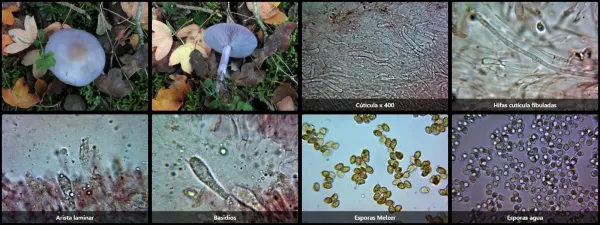
Microscopy of Lepista sordida