Lepista glaucocana
Taxonomy
Main synonym
Common names
Lepista blanquiazul, ziza zuri-urdin,
Geographic references:
Interactive map with data from GBIF.





Morphological Features:
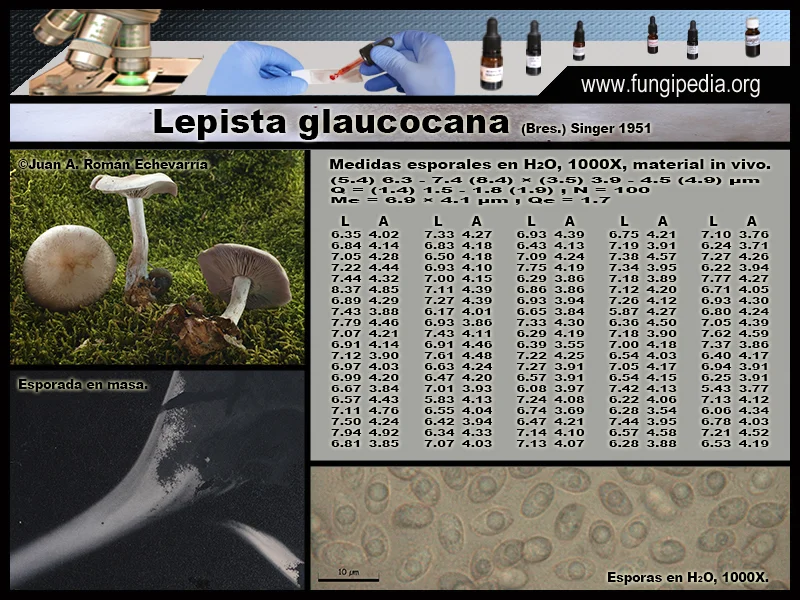
Pileus of fairly good size and stature, similar to other related species in its genus; the diameter of adult specimens typically ranges between 6 and 12 cm. It is hemispherical in early developmental stages, soon becoming convex, and finally flattened, with a raised or obtusely umboed center. Cuticle separable, smooth and matte, glabrous, white or cream-colored with a distinct lilac tint that is more pronounced in younger specimens; this tone tends to fade considerably with development, while the center often acquires an ochraceous hue. Margin involute for a considerable time, smooth, and barely striate except under extreme humidity.
Lamellae typically emarginate, sometimes merely adnate, separating with some ease from the flesh of the pileus; notably crowded, not overly thick, and fairly straight, with interspersed lamellulae. They share a color similar to the pileus: lilac-white in youth, later taking on a pinkish tint as spores are deposited, which form a light pink spore print. The edge is entire and concolorous with the hymenial face.
Stipe cylindrical, centrally attached to the pileus, proportionate in size to its diameter, usually broadened at the base, although this trait is somewhat variable; of good thickness and stature. It shares a color similar to the rest of the basidiome, though it occasionally acquires a more greyish tint; generally fibrillose, sometimes with longitudinally arranged fibers.
Flesh rather thick and firm, generally fibrous but especially in the stipe; whitish or cream-colored like the rest of the carpophore, with a slight lilac tint when young. It possesses an intense, distinctive, and unmistakable odor within the fruity spectrum, yet highly nuanced; it is one of those species identifiable by its characteristic smell. Its raw taste transitions from sweet to slightly bitter after a short while.
Habitat:
The specimens collected for this study were found in Galdakao, Bizkaia, in the nursery area of Monte Ganguren, fruiting at the edge of a track with nearby pine and oak trees. Bibliographically, it is referenced primarily under broadleaf trees and more rarely beneath conifers, on nutrient-rich or nitrogenous soils. Although considered infrequent or scarce, we observe it annually with relative frequency; it typically fruits in clusters of several specimens, and we have never encountered it isolated. Its preferred season for fruiting is autumn, although it occasionally appears during very rainy and cool springs; it is not a cold-adapted species like others in the genus Lepista.
Observations:
This species is considered a mediocre edible, as although its texture is not poor, its somewhat bitter taste leaves much to be desired. It is characterized by the uniform white or cream-lilac coloration of the entire basidiome, and by its distinctive, characteristic odor that makes it relatively easy to recognize. An inexperienced collector might confuse it with other related species such as Lepista nuda or lepista sordida, which exhibit much more pronounced lilac tones and possess a different odor and taste. It is far more similar to Lepista irina, which lacks any lilac tint and has a very intense, equally characteristic floral odor.
Microscopy of Lepista glaucocana