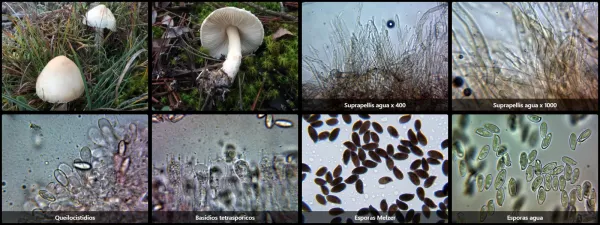
Lepiota erminea
Taxonomy
Main synonym
Common names
Lepiota blanca.
Geographic references:
Interactive map with data from GBIF.




Morphological Features:
Pileus rather small, rarely exceeding 5 cm in diameter, bell-shaped in its early stage, becoming convex, and finally plano-convex, retaining an umbo or obtuse prominence at the center. The surface is white, except for the umbo and generally the central zone, which gradually stains yellowish-ochre as the specimen matures. Fibrillose in appearance when young, with a margin covered in fibrils that tend to disappear due to rain.
Lamellae free from the stipe, whitish, becoming somewhat creamy at maturity, regular.
Stipe cylindrical and similar in length to the pileus diameter or somewhat longer, white and smooth in the upper portion up to the ring, floccose or tomentose below. Ring filamentous and evanescent, matching the color of the rest of the stipe.
Flesh scanty, thin, white. The odor is not particularly pleasant, and the taste has a bitter undertone.
Habitat:
This species should be considered rare due to its highly localized distribution; however, where it occurs, it does so profusely. Its habitat consists of grassy meadows or the margins of herbaceous paths. The photographed specimens were found in the Burgos locality of Gumiel de Izan in November; although fruiting typically occurs earlier, the individuals numbered in the hundreds.
Observations:
This is a small lepiota unmistakable due to its white coloration and heliophilous habitat. The group of small lepiotas is highly dangerous, as it includes several deadly species; this is not the case here, as it is innocuous but unpleasant-tasting. It is related to Lepiota clypeolaria, which has a much more scaly pileus and is typical of broadleaf woodlands. It may also bear some resemblance to Lepiota magnispora, which features a yellowish veil and is more characteristic of coniferous habitats.