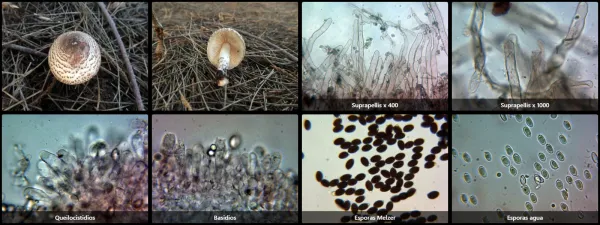

Lepiota brunneoincarnata
Taxonomy
Main synonym
Common names
Lepiota marrón rojiza.
Geographic references:
Interactive map with data from GBIF.
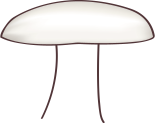
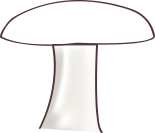


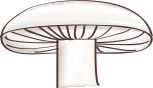
Morphological Features:
Pileus of small to medium size, with a diameter ranging from 2 to 5 (7) cm; initially hemispherical at emergence, soon becoming convex, and finally expanded. Cuticle with a background color ranging from cream to flesh-toned, but covered with abundant reddish or purplish scales; these are more densely packed at the center and become dispersed towards the margin, with the scaly coloration always being predominant in encountered specimens. Margin generally excurrent and floccose in young individuals.
Lamellae free from the stipe, closely spaced in young specimens and clearly distant in older ones, whitish to cream in color. The lamellar edge is distinctly crenulate.
Stipe proportional in size to the pileus diameter; similarly bearing a cream or flesh-toned color that prevails in the upper third, while the remainder is adorned with scales of a color similar to the pileus, more prominent in young specimens and losing definition with age. Bears a fugacious ring that is better described as a cortinate zone, clearly demarcating the smooth region from the scaly one.
Flesh rather scant, white in the pileus and pinkish in the stipe, with vinaceous tones at its base; odor weak and taste sweet.
Habitat:
We have observed a proliferation of this species in recent years in public gardens and ruderal areas in general, which has led to known cases of severe poisoning. It is usually quite heliophilous; although we consider it somewhat cosmopolitan, a habitat along paths with broadleaf trees is typically referenced for it. However, our collections include specimens found under conifers, Picea abies and Pseudotsuga menziesii.
Observations:
Species belonging to section ovisporae, comprising a series of species that are difficult to catalog macroscopically, making microscopic study indispensable. They all share, however, a common denominator: their high toxicity, which can prove fatal to humans upon ingestion. It is characterized by its fugacious ring or cortinate zone, purplish or reddish scaly covering, weak odor, and distinctly crenulate lamellar edge. There are many similar species that are also toxic or deadly, such as Lepiota helveola or Lepiota subincarnata; do not confuse with edible Macrolepiota species such as Macrolepiota procera, gracilenta, mastoidea, etc., which are always larger in size, possess a well-defined ring, and lack purplish scales.