
Leotia lubrica
Taxonomy
Main synonym
Common names
Leotia viscosa.
Geographic references:
Interactive map with data from GBIF.

Morphological Features:
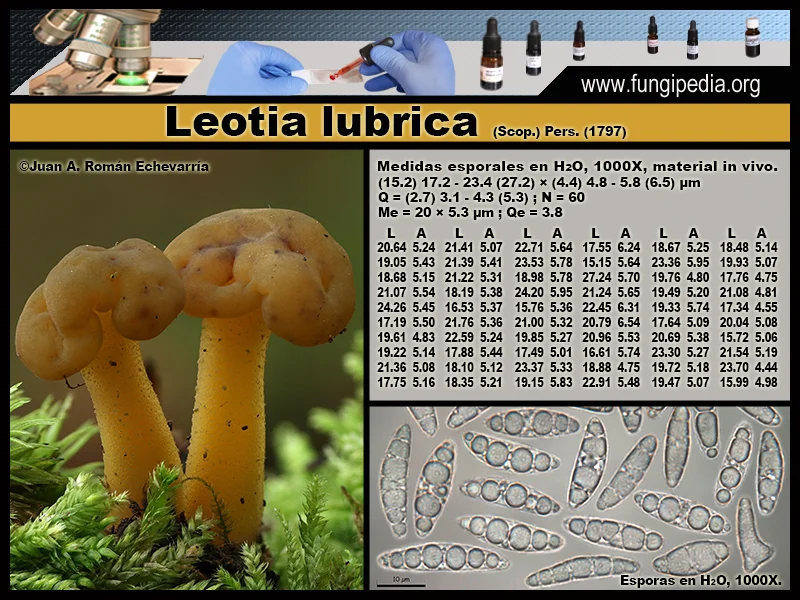
Pileus consisting of a very small gelatinous head measuring between 0.5 and 1 cm in diameter, clearly differentiated from the stipe, highly viscid, yellow with olivaceous tints, though it darkens upon drying to adopt more greenish tones.
Hymenium developing directly on the pileus, specifically on its convex surface, and is smooth.
Stipe long relative to the pileus, up to 5 cm tall, with a viscid consistency, even glutinous in rainy weather. It is smooth, generally curved, and yellowish in color.
Flesh also of gelatinous consistency, yellowish, and without any notable odor or taste.
Habitat:
Appears mainly during autumn, favoring grassy and very humid areas of forests; it is usually gregarious but never fasciculate. This fungus is quite common.
Observations:
A small gelatinous species lacking culinary value, morphologically similar to Cudonia confusa, which however is considerably less viscid and exhibits a flesh-colored tint. It can also be distinguished from Coryne atrovirens, which displays greenish-blue tones.
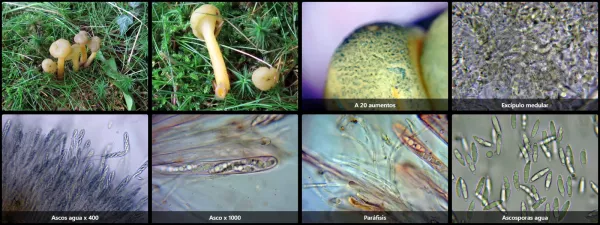
Microscopy of Leotia lubrica