
Lentinus tigrinus
Taxonomy
Main synonym
Common names
Katamotz-belarri.
Geographic references:
Interactive map with data from GBIF.


Morphological Features:
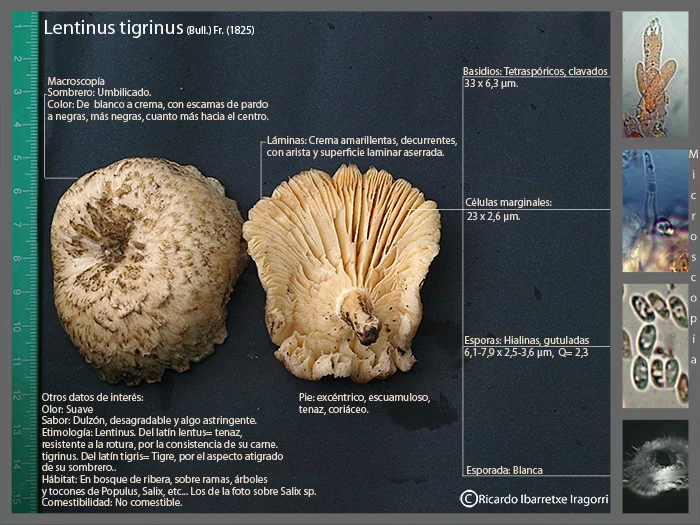
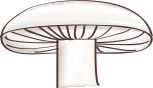
Pileus of variable dimensions, some adult specimens do not reach 5 cm in diameter, while others approach 10 cm; initially convex, soon becoming depressed and umbilicate at the center, finally infundibuliform. When very young, the specimen is entirely gray, but it quickly becomes scaly, cracking to reveal the flesh as a background; thus, adult specimens exhibit a highly scaly, tiger-striped appearance, with brownish-gray scales on a whitish background, these scales being more crowded at the center. Margin involute when young, later incurved and thin.
Lamellae markedly decurrent on the stipe, dense and crowded though not broad, initially whitish, tending toward yellowish-cream. The margin is finely denticulate, a characteristic feature of the genus.
Stipe cylindrical and centrally positioned or slightly eccentric, often curved. It is solid and elongated, whitish in background color, but covered with small scales of the same color as those on the pileus.
Flesh elastic and coriaceous in older specimens, rather thick and whitish. Its odor is pleasant, but its flavor leaves much to be desired; it is strong and, despite being sweet initially, has a slightly bitter undertone.
Habitat:
This species appears from spring onwards, associated with stumps, branches, and even living trees in decline. It typically fruits on riparian trees such as willow, poplar, or alder, and may also appear during autumn. It is a relatively uncommon species in our immediate surroundings.
Observations:
In some mycological treatises, young specimens are listed as edible; however, their flavor is very strong and their texture excessively tough. The genus Lentinus and the closely related Lentinellus are characterized by species that generally fruit on wood or decaying woody debris, as well as by their saw-toothed or denticulate lamellae, a feature particularly prominent in Lentinellus micheneri=Lentinellus omphalodes. We believe that the species presented here is truly unmistakable due to its tiger-striped cuticle.
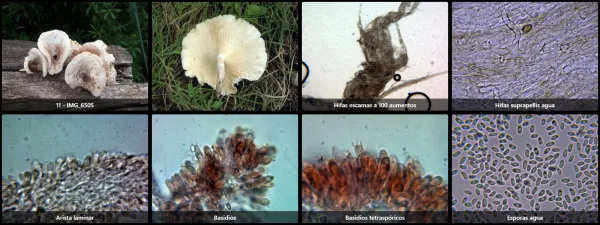
Microscopy of Lentinus tigrinus