Lentinula edodes
Taxonomy
Main synonym
Common names
Shiitake, seta de la vida, pyogo.
Geographic references:
Interactive map with data from GBIF.




Morphological Features:
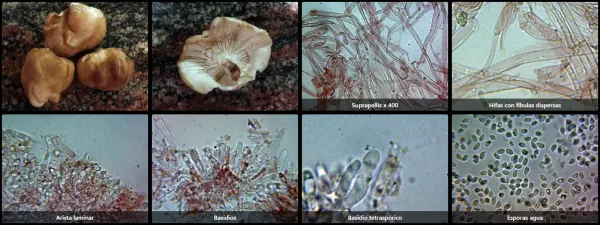
Pileus in most specimens has a diameter ranging from 5 to 10 cm, convex for much of its development, tending to flatten and even become slightly depressed in the final stages of maturity. The cuticle is dark brown, uniform in some specimens or fading toward the margin with ochraceous tones, initially smooth but soon covered with scales lighter than the background, low-relief and flat. The margin is involute in young specimens and incurved in adults, eventually becoming somewhat extended, weakly to not at all striate, and bearing remnants of the veil that tend to disappear over time.
Lamellae adnate, whitish in color, tending to become brownish or acquire yellowish tones with development, relatively crowded, with an edge that shows irregularities but does not become clearly denticulate as in Lentinus or Lentinellus.
Stipe short or well-proportioned, solid, similar in color to the pileus and quite fibrillose, frequently incurved at the base, bearing a transient cortinate band in the upper third formed by veil remnants.
Flesh thick and compact, whitish in color, with a quite pleasant fungal odor and a specific, characteristic flavor that is equally agreeable.
Habitat:
This is a species that in our region appears predominantly cultivated on woody substrate; it has also been located in nature in areas near cultivation sites, both in spring and autumn. It is an introduced species that fruits in clusters.
Observations:
Cultivation of this species in Eastern countries such as China dates back 1000 years; however, its introduction to Western Europe is relatively recent. Due to its characteristics, it is an unmistakable species. In nature, possible confusion may occur with Neolentinus adhaerens, a rare montane species, although its flesh is pungent and lacks the flat scales of the pileus. This species is a choice edible with a somewhat peculiar but pleasant flavor, to which medicinal properties are also attributed in various fields. An antitumoral polysaccharide is extracted from it, and its use as an antiviral or for the treatment of diseases such as arthritis is being studied.