

Lentinellus cochleatus
Taxonomy
Main synonym
Common names
Lentinelo anisado, anis-belarri, flota anisada.
Geographic references:
Interactive map with data from GBIF.




Morphological Features:
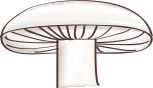
Pileus reaching up to 8 cm in diameter in mature specimens, though typically around 5 cm. Its shape is somewhat irregular, resembling a shell in early stages, but it soon tends to become depressed and ultimately infundibuliform. The surface is smooth, fundamentally ochreous-leonine in color, but sometimes with reddish tinges; when old, it may take on a more vinaceous tone, although ochre usually prevails. The margin is flexuose and tightly involute in young specimens, remaining less sharply involute in maturity; in some specimens it expands, but this is not common.
Lamellae strongly decurrent and crowded, whitish when young, later adopting dirty pinkish tones; one might say they become unattractive in maturity. The lamellar edge is notably strongly denticulate or irregularly serrate.
Stipe generally eccentric and sometimes lateral, almost never central; relatively short in proportion to the pileus except when it must extend beyond the bark. Flesh-colored to reddish-brown, lighter near the pileus and darker at the base. Typically hard and fibrous, and invariably curved due primarily to its growth habit.
Flesh thin and pale-colored, soft in young specimens but soon becoming coriaceous; quite tenacious and somewhat elastic, fibrous in the stipe. Emits a strong anise-like odor that persists even days after collection, with a similarly anise-like taste.
Habitat:
This is a lignicolous species; it has been collected on an oak stump in the province of Álava, where several groups of numerous specimens with caespitose growth were found around the stump, attached to it at the base near the ground. It is primarily autumnal and very uncommon.
Observations:
Although young specimens are considered edible by some authors, we do not recommend consumption as the flesh rapidly becomes coriaceous; furthermore, it is an uncommon fungus that should be protected. Despite its rarity, it is not a difficult species to identify: its caespitose growth on stumps, strongly serrate lamellae, and above all, its strong anise-like odor and taste are diagnostic. A variety inolens exists which lacks this characteristic odor; additionally, Lentinellus micheneri bears some resemblance, but it is smaller, has a pungent taste, and does not smell of anise.