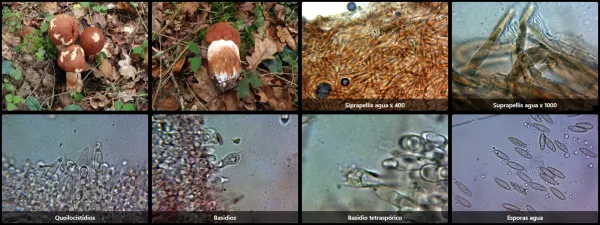

Leccinum aurantiacum
Taxonomy
Main synonym
Common names
Boleto anaranjado, onddo laranja, abró vermell.
Geographic references:
Interactive map with data from GBIF.




Morphological Features:
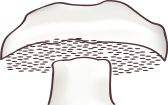
Pileus that can reach notable dimensions, fully developed specimens often exceed a diameter of 20 cm and have a very fleshy appearance. It is hemispherical in shape, soon becoming convex, and finally plano-convex, with a velvety cuticle in young specimens. The color is variable, reddish-brown or orange; in typical forms, the reddish component predominates. The margin is regular and often extending.
Tubes long, white in early stages, evolving to dirty grey tones and in old specimens practically brown with a vinaceous tinge; they are easily separable from the pileal flesh.
Pores small, their color follows a similar evolution to the tubes, rounded, they do not blue upon contact but tend to become slightly stained.
Stipe cylindrical, solid and firm, frequently exceeding 15 cm in length, white in background color but covered with numerous granulations that may initially be reddish or pinkish and more commonly brown or even black. It is common to find specimens with a clearly thickened base.
Flesh thick and firm in the pileus, especially in young specimens, and somewhat more woody in the stipe; over time it becomes spongier. White in color with various color changes upon cutting, often turning greenish-blue at the stipe base, and shifting to grey with a violet tinge elsewhere. It has a sweet taste and a pleasant odor.
Habitat:
This is a frequent and abundant species in our forests, where it stands out for its coloration and stature. It often fruits in groups, generally in Quercus, Populus or Betula woods, as well as under beeches, from late summer through autumn.
Observations:
This species is an acceptable edible, provided that only the pilei of young specimens are collected, as it becomes spongy and loses texture over time; the flesh tends to darken when cooked. The original description of this taxon proved erroneous; currently, what we formerly knew by Leccinum aurantiacum actually corresponds to Leccinum albostipitatum, and what we have always called leccinum quercinum is in fact Leccinum aurantiacum, understanding it as a European species, while reserving the name of Leccinum vulpinum for an American mountain conifer species. Due to its reddish tones, an inexperienced collector might confuse this species with Boletus pinophilus.